VoIP Hidden Fees to Watch Out For (So Your “$20/User” Quote Doesn’t Turn Into a Surprise Bill)
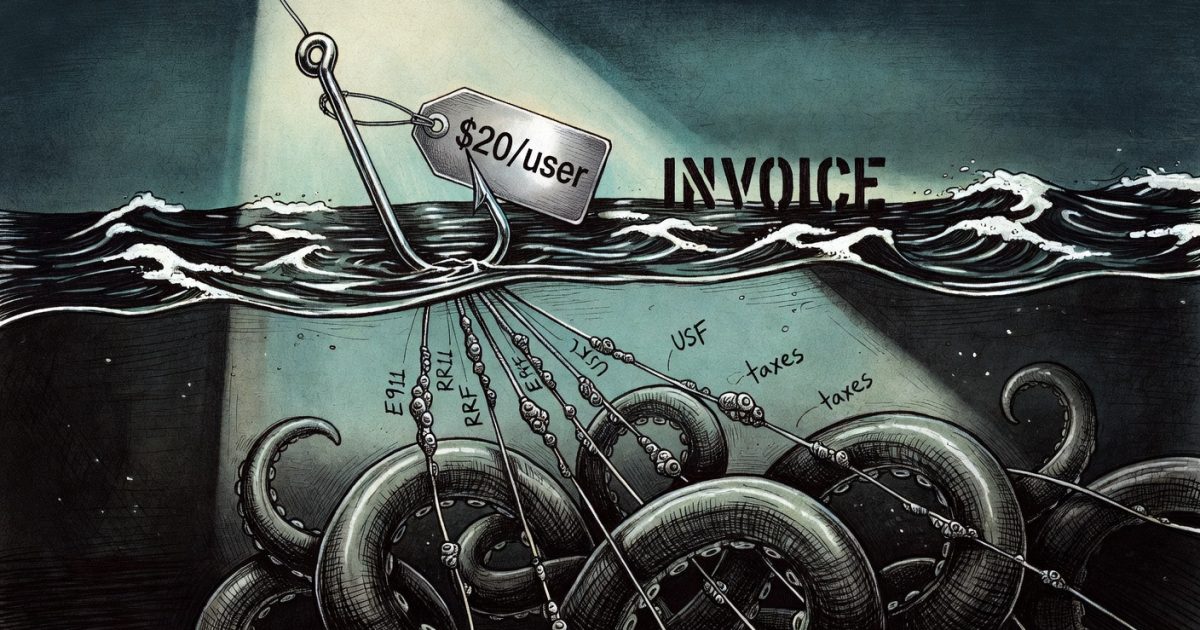
You know the moment: you sign for “$20/user,” you feel responsible and modern, and then the first invoice shows up with a second column of mystery line items that reads like a cable-company menu. That’s the part nobody mentions.
So here’s my promise: I’m going to translate the common VoIP hidden fees to watch out for into normal-person language, flag what’s unavoidable vs negotiable, and show you how to sanity-check a quote before you’re locked in. Most of these costs aren’t truly hidden—they’re just buried. The catch is that “buried” still costs money.
Key Takeaways
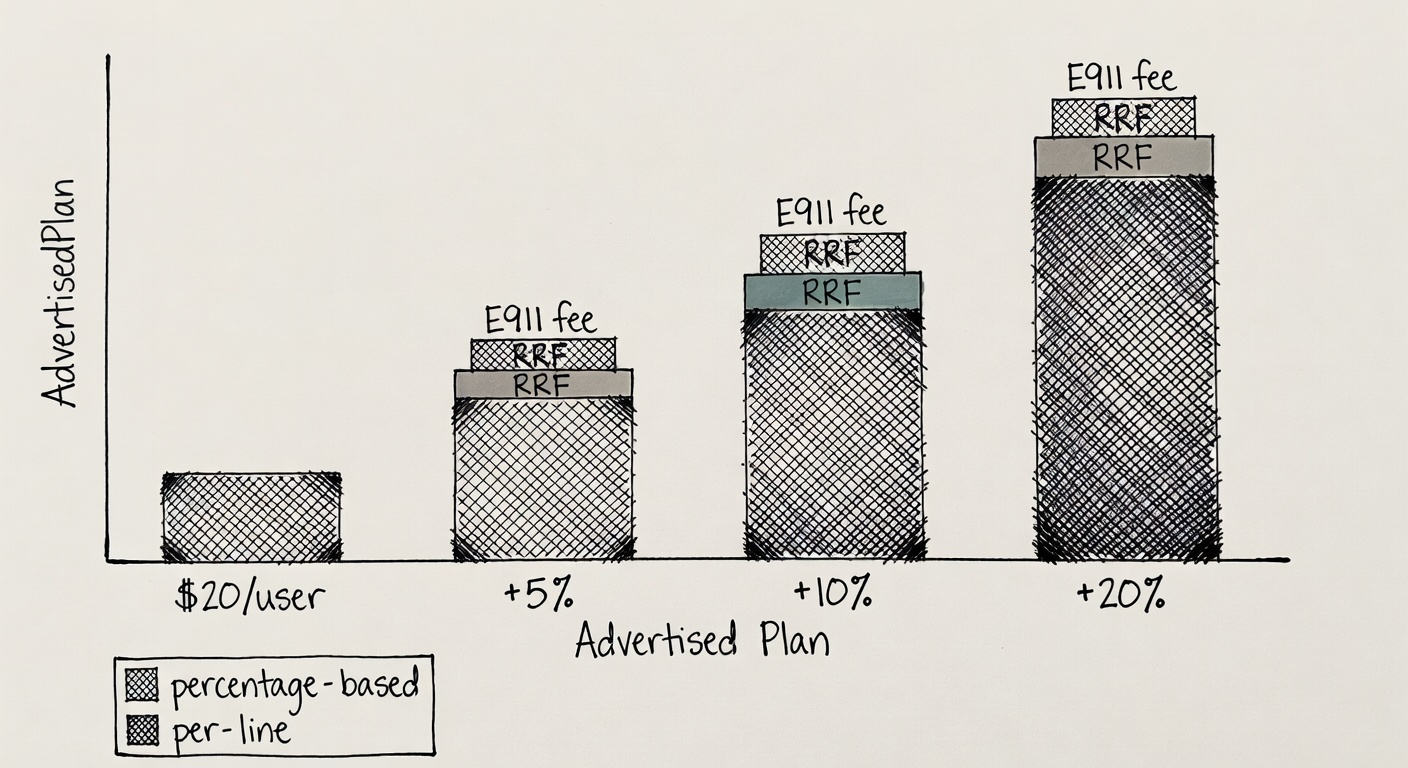
- Budget for taxes/surcharges on top of the advertised rate—some guides put this at 5–20% depending on location (Nextiva).
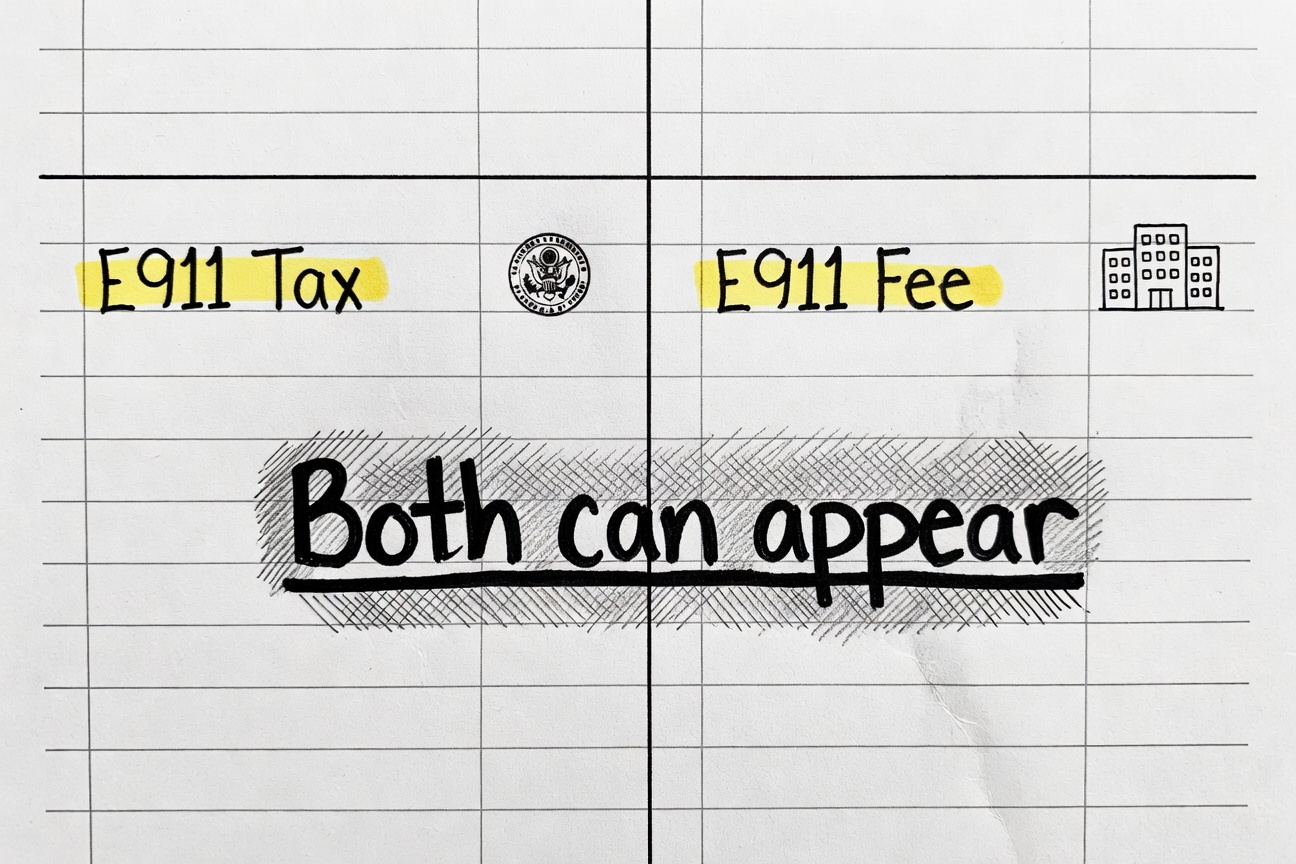
- E911 can show up twice: an E911 tax (government) and an E911 fee (provider) (RingCentral).
- USF/FUSF line items may be billed as a separate surcharge and are not a government-mandated tax (even if they look like one) (VOIP Networks).
- Watch for per-line “recovery” fees like RRF—Nextiva lists $3.95/line (Nextiva).
- Number porting might be free—or not. Example: VoIP.ms says US/Canada port-ins are free, but fax porting is $15/number (VoIP.ms).
- Toll-free inbound isn’t free to you: TeleCloud cites $0.02–$0.05/min typical (TeleCloud).
- Contracts and ETFs can dwarf “monthly savings” fast—TeleCloud cites $1,000–$10,000 as a typical range (TeleCloud).
| Fee | Typical Range | Negotiable? |
|---|---|---|
| E911 Tax (Government) | $0.20–$4.50/line | No |
| E911 Fee (Vendor) | $0.99–$1.50/line | Sometimes |
| RRF / Regulatory Recovery | ~$3.95/line | Comparable |
| USF/FUSF | 5–20% of total | No |
| Toll-free inbound | $0.02–$0.05/min | Yes |
| ETF | $1,000–$10,000 | Yes (trade) |
If you only read one section, make it the quote audit at the end.
The 3 Buckets of “Hidden” VoIP Costs (and which ones you can actually control)
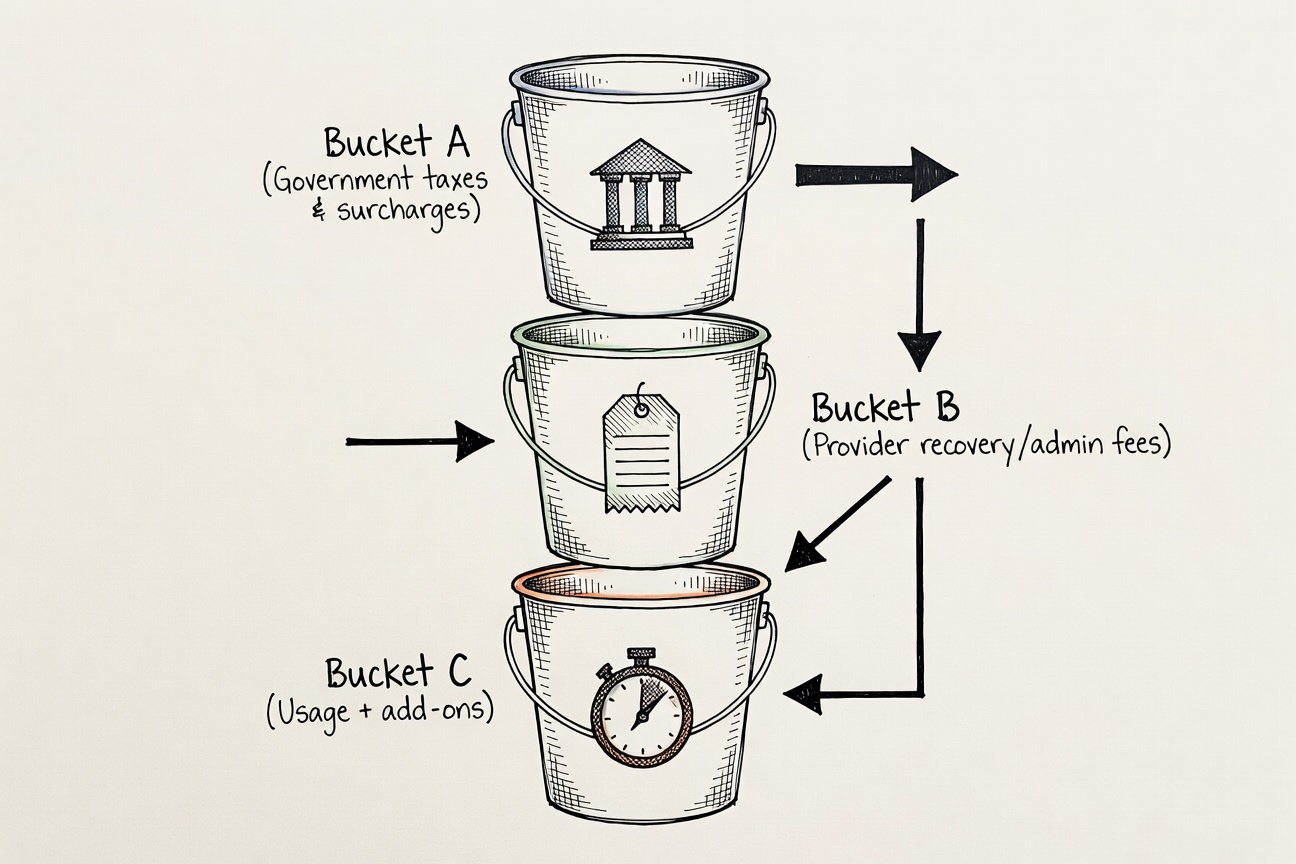
Most pricing confusion goes away if you sort everything into three buckets:
- Bucket A: Government taxes & surcharges (location-based; you can’t negotiate them)
- Bucket B: Provider-imposed recovery/admin fees (set by the provider; sometimes negotiable, always comparable)
- Bucket C: Usage + add-ons (depends on behaviour and growth; very controllable if you plan)
On a bill, these show up in different “shapes,” which is why they’re easy to underestimate:
- Percentage-based items (often USF-ish) scale with spend.
- Per-line/per-user fees scale with headcount and “lines,” including toll-free lines in some cases (Nextiva).
- Per-minute charges scale with call patterns (toll-free, international, overages).
Bucket A: Government taxes & surcharges (expect them to vary by address)
Taxes and government surcharges vary by service/billing address, and even decent providers will estimate them as a range. Nextiva says taxes and regulatory fees can add 5–20% on top of the monthly bill (Nextiva).
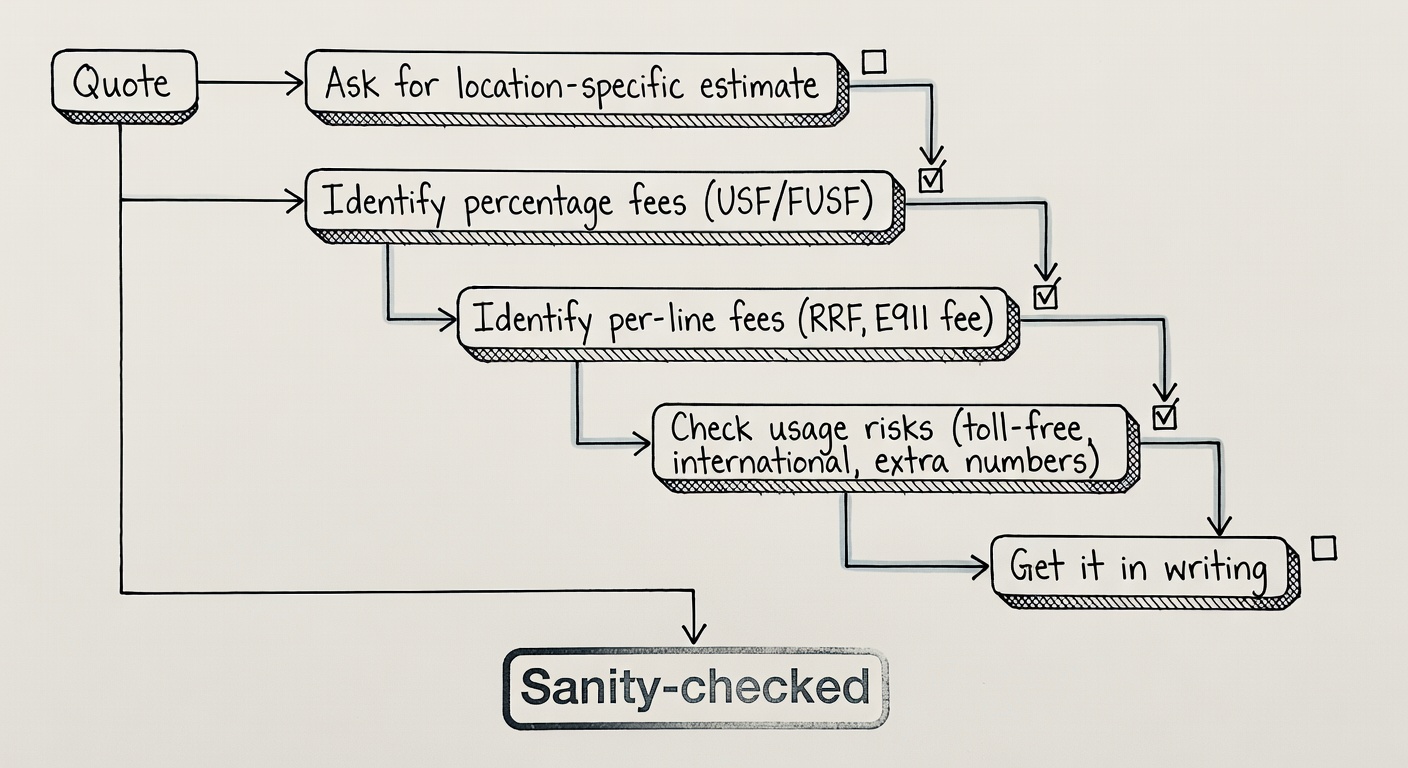
Practical move: ask for a location-specific estimate tied to your actual address and number footprint. If they won’t do that, assume the quote is marketing, not math.
Bucket B: Provider-imposed “recovery” fees (not taxes, but they look like them)
Some providers add fees to “recover” compliance costs and label them like they’re government pass-throughs. VOIP Networks is unusually blunt: its FUSF line item is a permissible pass-through surcharge but not a tax or charge mandated by the government, and its ARF (Administration Regulatory Fee) is also not government-mandated (VOIP Networks).
Translation: you still pay it, but you should treat it as part of the plan price when comparing vendors.
Nextiva publishes examples: Regulatory Recovery Fee (RRF) $3.95 per line and E911 fee $1.50 per line—both described as not government taxes (Nextiva).
Bucket C: Usage + add-ons (the stuff that quietly scales with behaviour)
This is where the “we’re growing!” moment turns into “why did the phone bill jump?”
Common creepers:
- toll-free inbound minutes
- international calling
- extra numbers (local, toll-free, vanity)
- feature add-ons
TeleCloud calls out toll-free inbound charges at $0.02–$0.05 per minute (TeleCloud). Before you sign, pull 60–90 days of call detail (or at least rough volumes). Otherwise you’re guessing.
Regulatory & “Compliance” Line Items: E911, USF/FUSF, and the fees that confuse everyone
A typical “bill screenshot in words” looks like this:
- Base plan: $20/user
- “E911”: $X.XX/line
- “E911 Tax” or “911 Surcharge”: $X.XX/line
- “Regulatory Recovery” / “Admin Regulatory”: $X.XX/line
- “USF” / “FUSF”: Y%
- State/local taxes: Z%
Some of those lines are government. Some are the provider. And sales teams love the confusion.
E911 fee vs E911 tax (yes, they can both show up)
RingCentral spells this out:
- E911 Tax: imposed by state/county/city; can range $0.20 to $4.50 per VoIP line depending on jurisdiction (RingCentral).
- E911 Fee: provider fee to offset the cost of providing 911 service; $0.99 per line per month (RingCentral).
Nextiva similarly lists an E911 fee of $1.50/line and calls it not a government tax (Nextiva).
So when someone says “E911 is included,” your follow-up is: included as a provider fee, a tax, both, or neither? Get it in writing.
USF/FUSF: why it’s often a percentage (and why providers label it differently)
VOIP Networks explains the mechanics: the FCC adopts a quarterly “contribution factor,” and the provider may bill a FUSF surcharge as a separate line item based on the invoiced amount subject to FUSF (VOIP Networks).
Two takeaways:
- It’s commonly percentage-shaped, so it scales with spend.
- It may be presented as a pass-through surcharge, but it’s not a government-mandated tax per VOIP Networks’ disclosure (VOIP Networks).
The question I always ask: What base is that percentage applied to? If the rep can’t answer, you can’t forecast.
Porting, Numbers, and “Wait, Why Am I Paying for My Own Phone Number?”
Phone numbers feel like they should be portable and boring. They are portable. They are not always boring.
Nextiva notes the FCC requires numbers to be portable (within the same geographic area/rate center) and says porting can take 5–7 business days for simple ports, while more complex ports can take 4–6 weeks (Nextiva). That timeline matters because downtime is the real cost.
Porting fees: could be $0, could be per-number—get it in writing
VoIP.ms shows the variability: US/Canada port-ins are free (as of Jan 15, 2020), but fax porting is $15 USD per number (VoIP.ms).
Nextiva says there’s no charge to port your number to Nextiva (Nextiva).
The move:
- Ask the new provider for port-in fees.
- Ask the old provider for port-out fees (VoIP.ms explicitly warns carriers may charge port-out fees) (VoIP.ms).
- Get both answers in writing.
Extra numbers, toll-free, and per-minute inbound charges
Toll-free is the classic “sounds free” trap. TeleCloud’s range for inbound toll-free is $0.02–$0.05/min (TeleCloud). Ask for the toll-free rate sheet and estimate minutes from real call logs—especially if marketing runs campaigns.
Contracts, Early Termination Fees (ETFs), and Auto-Renewals: the ‘big’ hidden cost
Don’t gloss over this.
TeleCloud cites a typical ETF range of $1,000–$10,000 depending on contract size and term (TeleCloud). Nextiva also warns early termination fees can be a flat fee or a big chunk of remaining contract value (Nextiva).
Two practical checks:
- Auto-renewal + notice window: what’s the cancellation deadline, and how do you submit notice?
- ETF formula: is it a flat fee, remaining months, or a percentage?
A 10-Minute Quote Audit: Questions to Ask Before You Sign (and what a ‘transparent’ quote looks like)
Ask for an itemized quote that shows every recurring and one-time cost. Then run this checklist.
-
“What’s the all-in monthly cost for X users at my address?”
Taxes vary by location; don’t accept a generic estimate (Nextiva). -
“Which line items are government taxes vs your company’s fees?”
Some pass-through surcharges are not government-mandated taxes (VOIP Networks). -
“Do you charge both an E911 fee and an E911 tax?”
Because yes, both can appear (RingCentral). -
“What is your RRF/ARF/regulatory recovery fee per line?”
Example: Nextiva lists $3.95/line RRF (Nextiva). -
“What’s the USF/FUSF percentage, and what base is it applied to?”
If they can’t explain the base, you can’t forecast. -
“Porting: what do you charge, and what might my current carrier charge?”
Porting can be free (VoIP.ms US/Canada) or not (fax porting $15/number) (VoIP.ms). -
“Toll-free: what’s the per-minute inbound rate, and are there minimums?”
TeleCloud’s $0.02–$0.05/min is a decent sanity band (TeleCloud). -
“Contract term, auto-renewal, and ETF—spell it out.”
If the ETF is four figures, it’s not a footnote (TeleCloud).
Want a quick reality check? Take your quoted per-user price and add:
- a tax/surcharge buffer (often 5–20% depending on location) (Nextiva)
- per-line provider fees (RRF/E911-style)
- your expected toll-free usage
Then compare providers on that number, not the headline.
Calculate Your Real VoIP Cost
Before signing up, run the real numbers on our VoIP calculator → https://telcoblade.com/#calculator.
Sources
- TeleCloud — Hidden costs with a VoIP phone system
- RingCentral — E911 Tax FAQ (E911 fee vs tax)
- Nextiva — VoIP taxes, surcharges and fees (RRF/E911 fees)
- VOIP Networks — Regulatory fees disclosure (FUSF/ARF not government-mandated)
- VoIP.ms — Porting a Number (free port-ins; fax porting $15)
- Nextiva — VoIP cost guide (taxes/fees; ETFs)