
How Much Does VoIP Cost for a Small Business? Real-World Pricing (and the Fees That Bite)
If you’re Googling how much does VoIP cost for small business, you’re probably staring at a tidy “$15/user” headline and wondering why your quote (or first invoice) doesn’t look tidy at all. That’s the paper cut: advertised pricing is only half the story, and the other half is line items with names that sound like they were generated by a fax machine.
Key Takeaways
- Expect $15–$50 per user/month for hosted VoIP, with many small businesses landing around $25–$35 depending on features and contract length (TeleCloud).
- If a plan looks too cheap, assume limits, missing features, or fees waiting offstage.
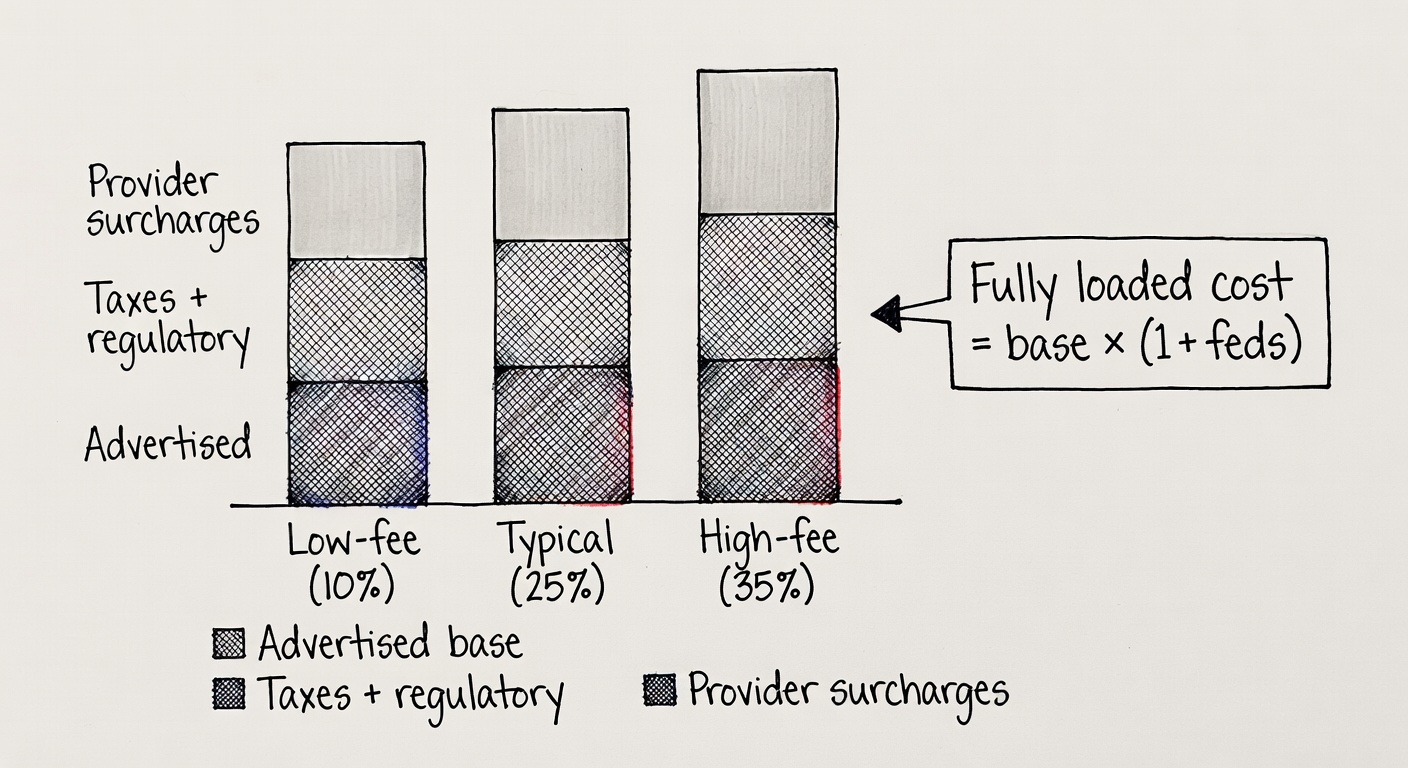
- Taxes, regulatory charges, and provider “recovery” fees can raise the real bill by 20–30% or more in some cases (TeleCloud).
- Budget for one-time costs like porting (up to $30/number) and US carrier registration ($19) depending on provider and setup (Quo).
- The clean way to compare providers is fully loaded cost per user and a 12–24 month total cost of ownership—not the marketing price.
Calculate your exact VoIP cost (in 60 seconds)
Want a real number, not a headline? Use the VoIP cost calculator to estimate your fully loaded monthly cost based on employee count, locations, and the features you actually need.
Direct link: https://telcoblade.com/#calculator
The Baseline: What Small Businesses Typically Pay Per User (and Why the Range Is So Wide)
Hosted VoIP is basically “your phone system as a cloud service”: you pay a monthly rate per user (or per line), and calls run over your internet connection. The range is wide because “VoIP” can mean anything from a basic dialer to a full UCaaS suite with analytics, call recording, and integrations.
Here’s the sanity-check range I use when someone sends me a quote:
- $10–$40 per user/month is a common hosted VoIP range (Vonage).
- $15–$50 per phone line/month is another common framing (per-line pricing) (Nextiva).
- $15–$50 per user/month, with many businesses around $25–$35, is a realistic “most people” band (TeleCloud).
If you’re seeing <$15/user, don’t panic—but don’t assume you found a loophole. Assume trade-offs (feature caps, metered stuff, add-ons, or… fees). This is where people get burned.
Typical monthly ranges you’ll actually see
- $10–$40/user (hosted VoIP baseline range) (Vonage)
- $15–$50/line (common per-line range) (Nextiva)
- $15–$50/user, with $25–$35 typical for many small businesses (TeleCloud)
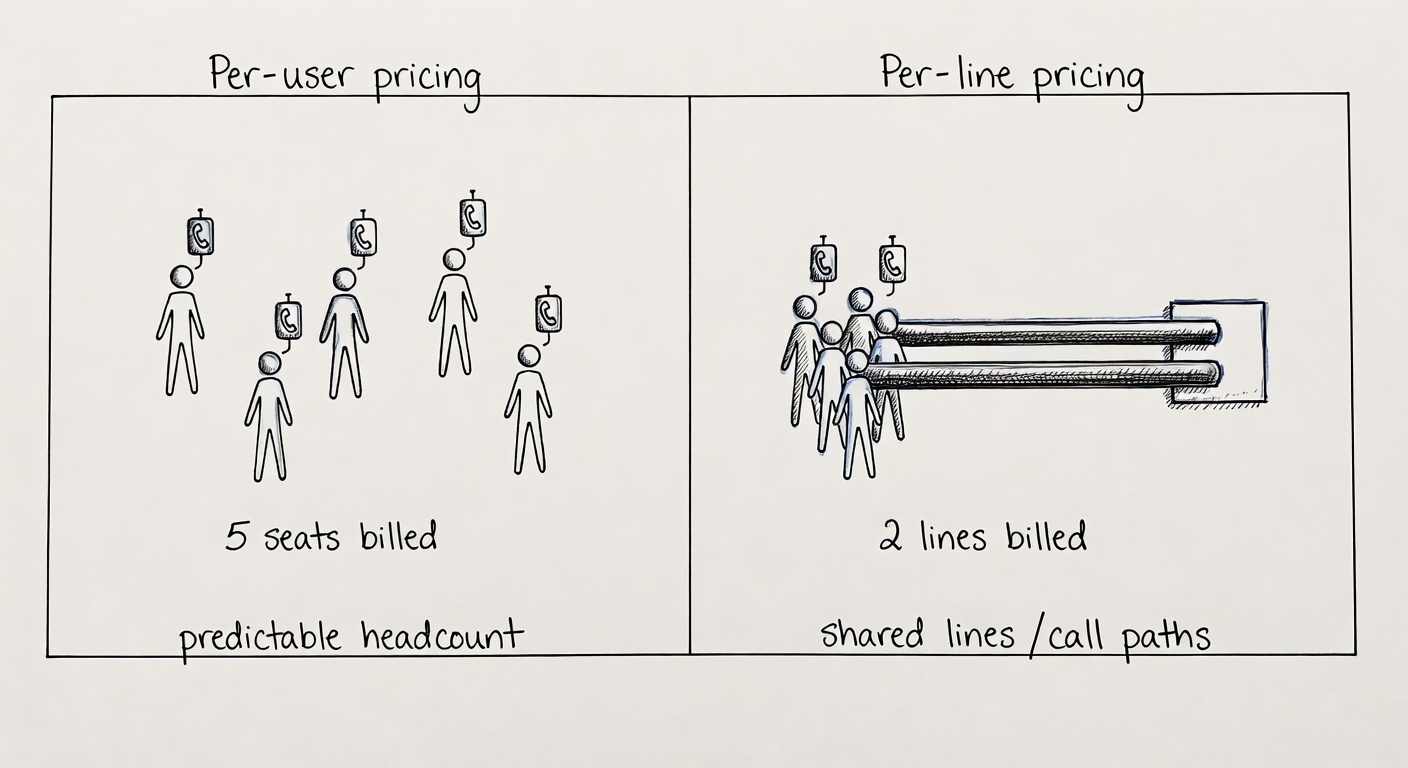
One quick translation: “per line” ≠ “per user.” A “line” might be a shared seat, a call path, or a billed endpoint depending on the provider. Ask what they mean before you compare.
Worth it? It depends on that one detail.
Per-user vs per-line pricing: which one usually wins for small teams?
Per-user is usually the cleanest for small teams because headcount is predictable. Per-line can win if you have a call-heavy setup where a few shared lines cover many people (think: a shop phone, a support queue, a couple of shared extensions).
Nextiva’s own breakdown frames it similarly: per-user fits defined headcount; per-line can fit call-intensive orgs that need multiple lines (Nextiva). TeleCloud also leans on per-user budgeting for small business predictability (TeleCloud).
If you’re a call-heavy business, ask providers to quote both models. Same headcount, different math. I’ve seen it flip the decision.
The Real Cost: Taxes, Regulatory Charges, and “Not-a-Tax” Surcharges
Okay, now let’s talk about the part you’ll feel every day: the invoice.
Even with a “clean” plan price, the real bill can jump once you add taxes, regulatory charges, and provider-created surcharges. TeleCloud’s warning is blunt: those extras can push actual cost 20–30% or more above the advertised base in some cases (TeleCloud).
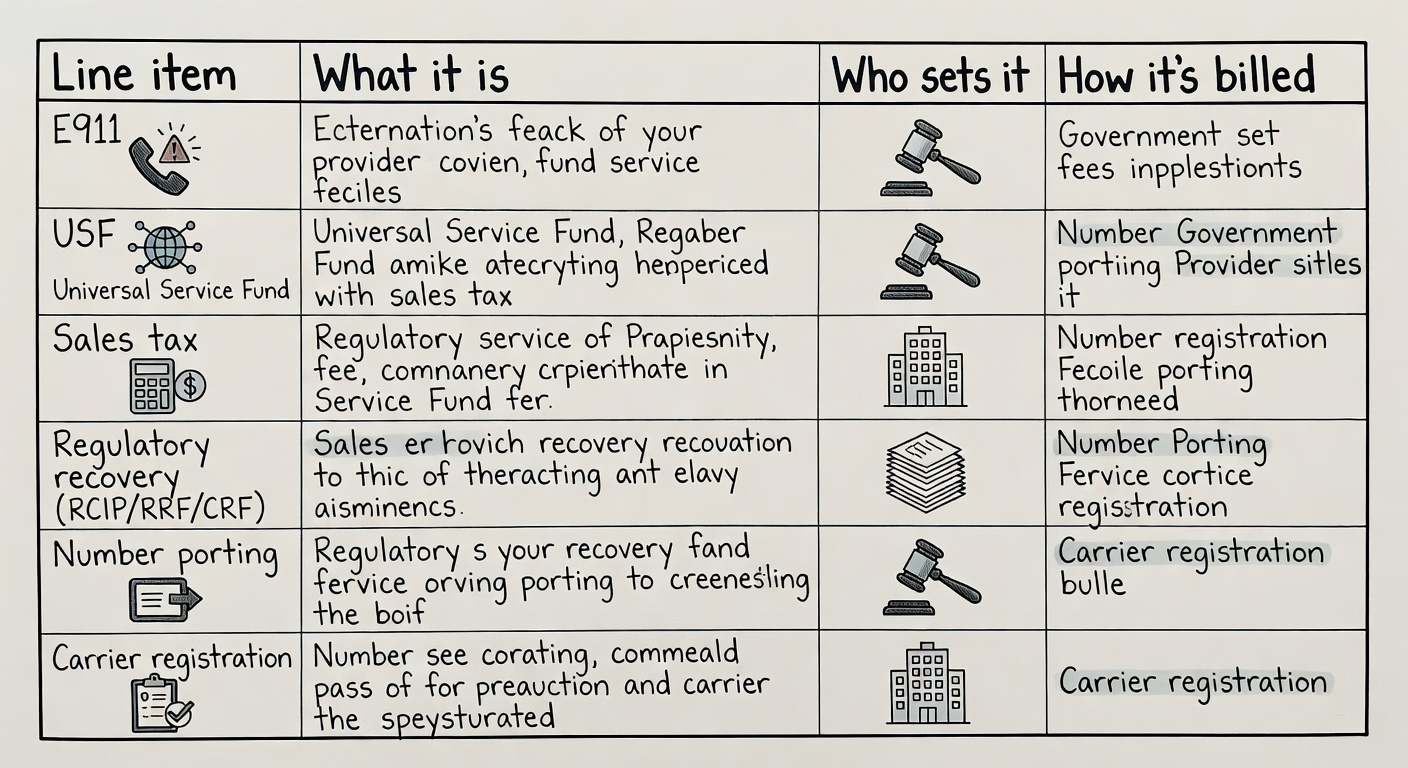
- Taxes (state/local sales-type taxes, where applicable)
- E911-related charges (emergency calling support)
- USF-related charges (universal service funding pass-throughs)
- Provider “recovery/compliance” surcharges (the ones that aren’t literally taxes)
- Per-number/per-line add-ons (extra DIDs, toll-free, etc.)
Want the complete breakdown of hidden VoIP fees?
If you want the full “what is this line item and why am I paying it?” version—including E911, USF, RRF/CRF/RCIP-style surcharges, and real invoice examples—those details live in the dedicated hidden-fees guide.
One-Time and “Sometimes” Costs: Porting, Registration, Hardware, and Network Upgrades
Before we get lost in specs, here’s what changed my mind after watching too many small businesses switch: the upfront stuff is rarely catastrophic, but it’s often annoyingly under-disclosed.
Number porting + carrier registration: small line items that still matter
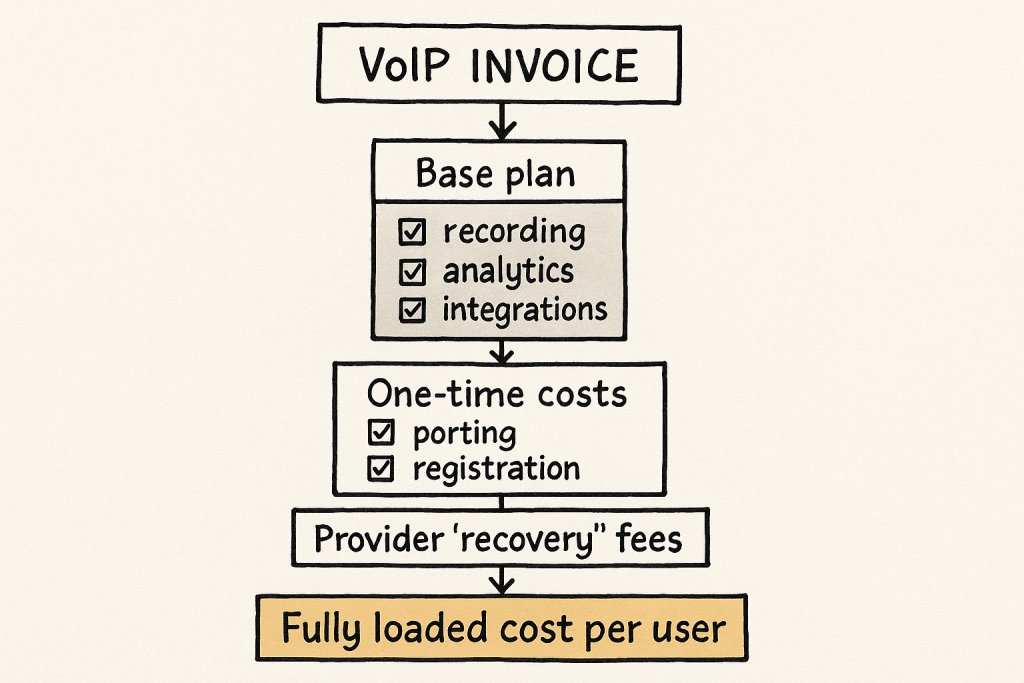
Quo’s breakdown calls out two common one-time costs:
- US carrier registration: $19 one-time (Quo)
- Number porting: can cost up to $30 per number, provider-dependent (Quo)
Nextiva also frames porting as a typical implementation consideration (and notes some providers include it) (Nextiva).
Ask, directly: “Is porting included? If not, what’s the per-number fee?” Don’t gloss over this.
Now plug those one-time items into the calculator and look at your 12–24 month total: https://telcoblade.com/#calculator.
Hardware: when you can skip it (softphones) vs when you can’t (fax/analog)
Most teams can start with softphones (desktop/mobile apps) and buy hardware only for roles that truly need it. But if you’ve got a physical fax machine, an analog door buzzer, or some legacy device you can’t kill yet… you may need adapters.
To make the budgeting real, here are order-of-magnitude prices from SpectrumVoIP’s adapter store:
- Fax adapter: $220 (AudioCodes MP-202D) (SpectrumVoIP)
- ATA/telephone adapter: $95 (Grandstream HT813) (SpectrumVoIP)
- VoIP gateway: $199 (Grandstream HT818) (SpectrumVoIP)
Prices vary, but this is the ballpark. And yes, I’ve been the person digging through a drawer of labelled cables trying to make an ATA behave.
If you can skip hardware, skip it. If you can’t, budget it upfront.
A Simple Cost Calculator (No Spreadsheet Required): Estimate Your “Fully Loaded” Monthly Bill
Now, if you’re thinking “I just want a number I can trust,” same.
Provider calculators can be useful, but they often exclude the messy parts. Ooma’s savings calculator, for example, explicitly says hardware costs and monthly applicable taxes and fees are not included (Ooma). Credit where it’s due: at least that’s honest.
Here’s my transparent “fully loaded” method:
My quick calculator (copy/paste and plug in your numbers)
Inputs
- Users =
U - Advertised plan price per user =
P - Extra numbers (beyond what’s included) =
Nat$X/number(if applicable) - Estimated taxes/fees/surcharges rate =
F(use 0.20 to 0.30 as a planning range if you don’t have a sample invoice yet) (TeleCloud)
Formula
- Base monthly =
U × P + (N × X) - Estimated fully loaded monthly =
Base monthly × (1 + F)
Want a slightly more conservative estimate? Run it twice: once at 20%, once at 30%. If that spread changes your buying decision, you need a better quote.
If you only read one section, make it this one.
Interactive “all-in” table (pick your team size)
Assumptions (so you can edit them):
- Plan price shown = $25/user (common “mid-tier” example)
- Fees range = +20% to +30% (TeleCloud)
| Employees | Advertised ($25/user) | Est. all-in (+20%) | Est. all-in (+30%) |
|---|---|---|---|
| 5 | $125/mo | $150/mo | $162.50/mo |
| 15 | $375/mo | $450/mo | $487.50/mo |
| 50 | $1,250/mo | $1,500/mo | $1,625/mo |
That’s not a quote. It’s a planning tool.
Worked example: 10 users at $25/user — what happens after fees?
Base is easy: 10 × $25 = $250/month.
Now apply the “fees happen” reality:
- At +20%, you’re at $300/month
- At +30%, you’re at $325/month
That 20–30% uplift is exactly the kind of jump TeleCloud warns about when fees are buried in the fine print (TeleCloud).
The quick version: it works. The longer version: it works… like this.
How to Shop Without Getting Burned: 9 Questions to Ask for an Apples-to-Apples Quote
Now for the thing I didn’t expect to care about: how a provider answers basic billing questions.
Use this checklist (and yes, be a little annoying about it):
- What’s the fully loaded monthly total for my address and my user count? (TeleCloud)
- Can you itemize every tax, fee, and surcharge on a sample invoice?
- Which line items are government-mandated vs provider-created? (TeleCloud)
- What are your E911 and USF pass-through practices? (And do they change?) (VoIP Office)
- Do you charge a regulatory recovery / compliance recovery fee (RRF/CRF/RCIP-style)? How much per seat/line? (TeleCloud)
- Is number porting included? If not, what’s the per-number cost? (Porting can be up to $30/number.) (Quo)
- Any one-time registration fees I should expect? (Example: $19 carrier registration in Quo’s breakdown.) (Quo)
- What are the contract terms, and are there cancellation fees or auto-renewals? (Quo)
- If fees change, do you notify customers, and can you show where that’s stated?
I’d recommend it, with conditions. And yes, the conditions matter.
CTA: Get your “all-in” number with the calculator
If you’re at the “okay, but what will we pay?” stage, use the interactive calculator and compare providers on the only number that matters: fully loaded cost per user (and your 12–24 month total).
Direct link: https://telcoblade.com/#calculator
Then make the decision with one rule: pick based on the one thing you can’t tolerate—surprise fees, contract lock-in, or hardware faff.
Sources
- TeleCloud — How much does a VoIP Phone System Cost for Small Businesses?
- TeleCloud — Buyer Beware: Look Out for Hidden Fees from National VoIP Providers
- Vonage — VoIP Pricing Guide: Plans, Monthly Costs & How It Works
- Nextiva — How Much Does VoIP Cost?
- VoIP Office — VoIP Taxes: What Your Provider is Legally Allowed to Charge
- Ooma — VoIP Savings Calculator (taxes/fees not included note)