
Wireless Earbuds With ANC Comparison (2026): What Actually Matters After the Honeymoon Period
Picture a packed subway car, someone’s backpack digging into your ribs, and a drummer (always a drummer) practising on a plastic bucket. You put in your “best ANC earbuds” and… it’s fine. Not magic. Fine.
That’s the buying question: which wireless earbuds with ANC stay pleasant on day 11, when you’re not babying them, the app has updated twice, and your ears have opinions.
ANC and sound matter. But fit, ecosystem perks, and software paper cuts decide whether you actually keep them.
Key Takeaways
- ANC is inseparable from fit/seal. If your tips don’t seal, you’ll think the ANC “isn’t that good,” and your friend will swear the same earbuds are unbeatable. The MacRumors thread basically turns into a case study in this disagreement loop—and even calls out fit as the likely culprit in one comparison (MacRumors).
- Cross-brand “best ANC” rankings are squishy. Adaptive EQ and other processing can flip impressions fast (MacRumors).
- Multipoint exists on true wireless, but it’s not universal. Some people still assume it’s impossible—then get surprised when a model like the Jabra Elite 85t does it (AppleVis).
- Ecosystem perks can outweigh raw tuning. If you’re on iPhone, Apple’s integration can be the “least annoying” path even when sound debates rage.
- Plan for firmware/app friction. If your patience for mandatory apps is basically zero, factor that in up front.
How I’d Compare ANC Earbuds Without Lying to You (Method + What to Ignore)
Most “comparisons” pretend there’s a single leaderboard. There isn’t.
Here’s a repeatable approach that’s close enough for buying decisions:
- Same phone, same streaming app, same tracks.
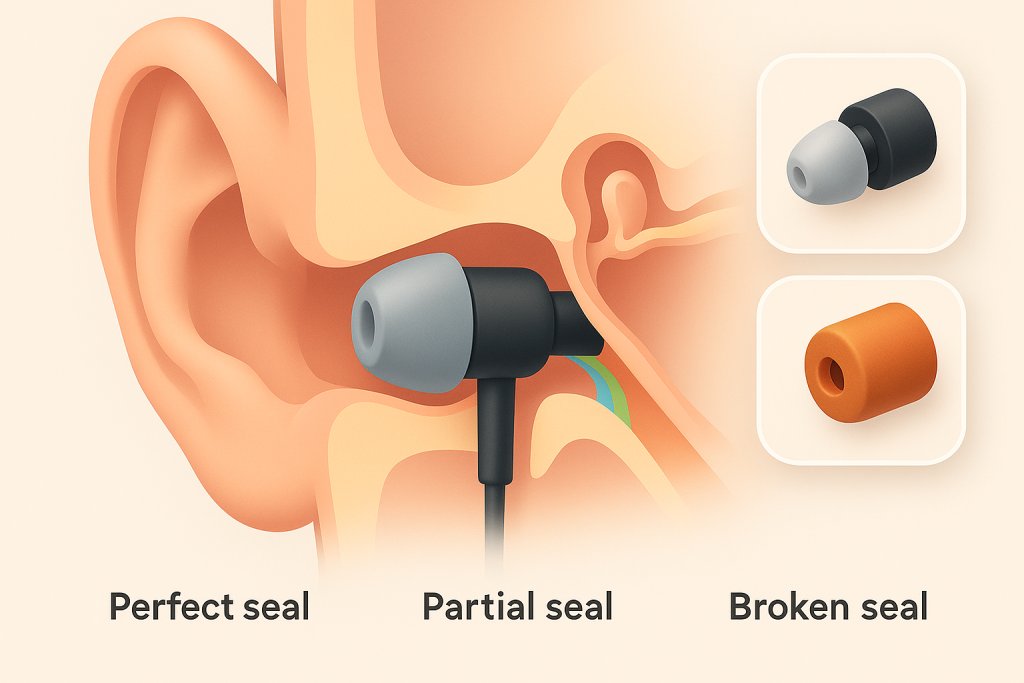
- Same tips (or at least same type). Silicone vs foam changes isolation and perceived treble.
- Same environments, on purpose: commute rumble, café chatter, windy corner, treadmill/run, flight if you can.
- Volume-match by habit, not vibes. If one pair is louder, you’ll “prefer” it.
- Lock settings: fixed ANC mode, transparency off, consistent wind reduction (if available).
And yes—adaptive EQ makes A/B testing messy, especially across brands. One MacRumors user nails it: “It’s all subjective and really hard to compare especially when Apple uses an adaptive EQ” (MacRumors).
Firmware can change the whole story. Re-test after updates, even if it’s annoying. It usually is.
If you hand this to a non-technical friend, do they succeed—or do they text you for help?
ANC in Real Life: Commute Noise vs Voices vs Wind (and Why ‘Better’ Depends)
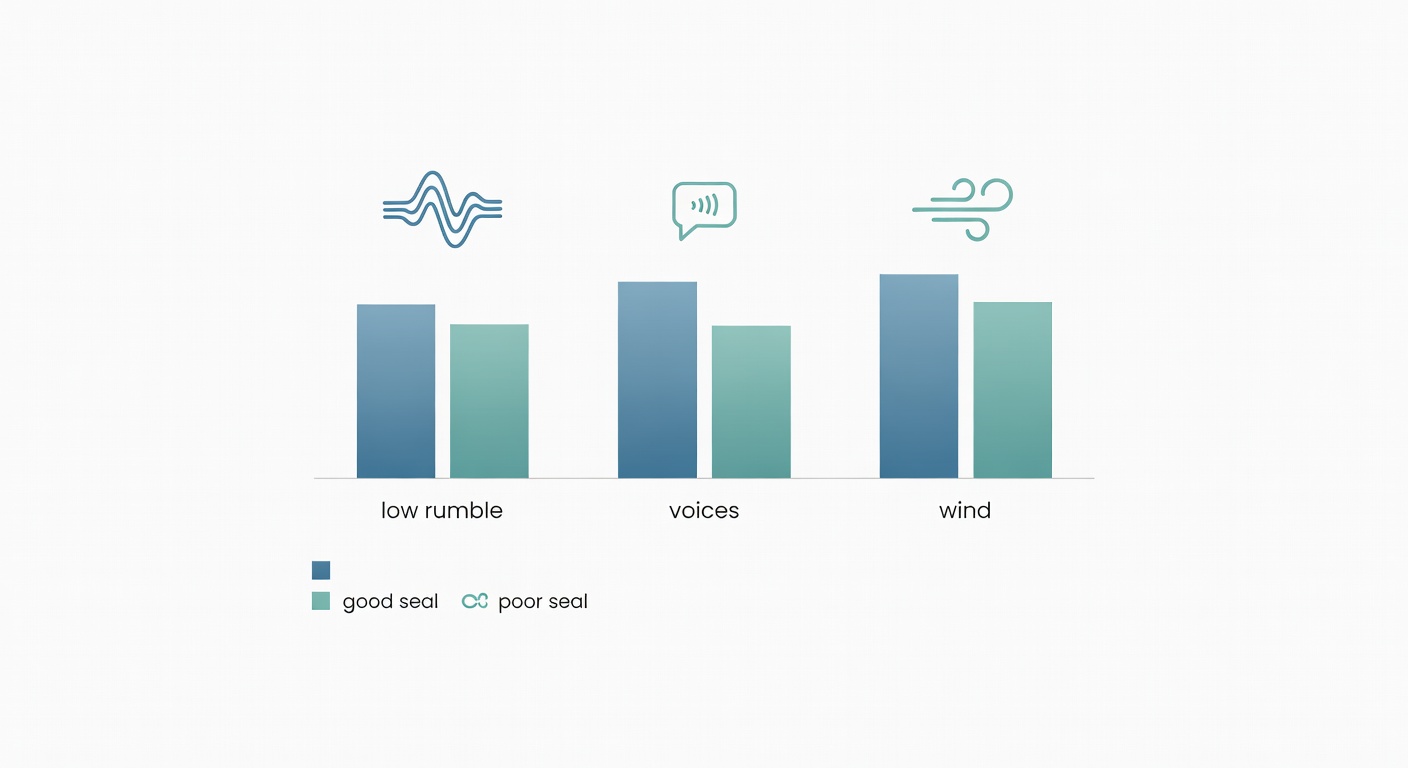
ANC isn’t one thing. It’s a bundle of trade-offs:
- Low-frequency rumble (bus/plane): biggest “wow,” also where pressure sensation can show up.
- Voices (office/café): harder to erase cleanly; some reduce volume but leave speech intelligible (good or maddening).
- Sudden clanks (dishes/platform noise): some sets “pump” or flutter.
- Wind: the silent killer; great earbuds can turn into a wind-reduction menu the second you step outside.
That “pressure” or “hollow” feeling is real for some people. In the MacRumors thread, one user praises a pair specifically because it doesn’t have that “hollow” sound they associate with over-ears (MacRumors).
Transparency mode isn’t a bonus; it’s a deciding feature. The same thread’s in-flight swapping anecdote calls out automatic awareness of flight attendants as “a nice bonus” (MacRumors). That’s not lab talk. That’s living with them.
Practical translation: if you can’t miss announcements, you might prefer slightly weaker ANC with better transparency. If you’re trying to sleep on a plane, you’ll tolerate more pressure for more rumble reduction.
Would you still recommend it if the “best ANC” makes you feel weird after 20 minutes?
ANC performance by noise type (numbers where we actually have comparable lab data)
| Model | Low rumble (airplane) | Voices (office) | Street mix | Wind & “clanks” | Notes |
|---|---|---|---|---|---|
| Apple AirPods Pro 2 | -23.46 dB attenuation (source) | -21.69 dB (source) | -25.48 dB (source) | Varies a lot by fit; wind handling is its own mode/algorithm (no directly comparable dB value in the provided lab set) | RTINGS Methodology v2.0; “better ANC” vs Sony in their verdict (source) |
| Sony WF-1000XM5 | -18.81 dB (source) | -18.64 dB (source) | -21.56 dB (source) | Foam tips can help passive isolation; wind can still trigger “why is my music breathing?” moments (again: no single shared dB metric here) | RTINGS notes foam tips contribute heavily to isolation (source) |
| “Other”: Jabra Elite 85t | No RTINGS-style attenuation values in provided sources | — | — | — | Included here because multipoint is a real buying hinge; battery + multipoint specs are documented (source) |
Method note: the dB values above are RTINGS “Noise Isolation – Common Scenarios” attenuation numbers, tested under their Methodology v2.0. They’re comparable within that lab, but don’t treat them as universal truth across every review site.
Fit Is the Hidden ANC Spec (Seal, Tips, and Why Your Friend Disagrees)
This is the part that matters.
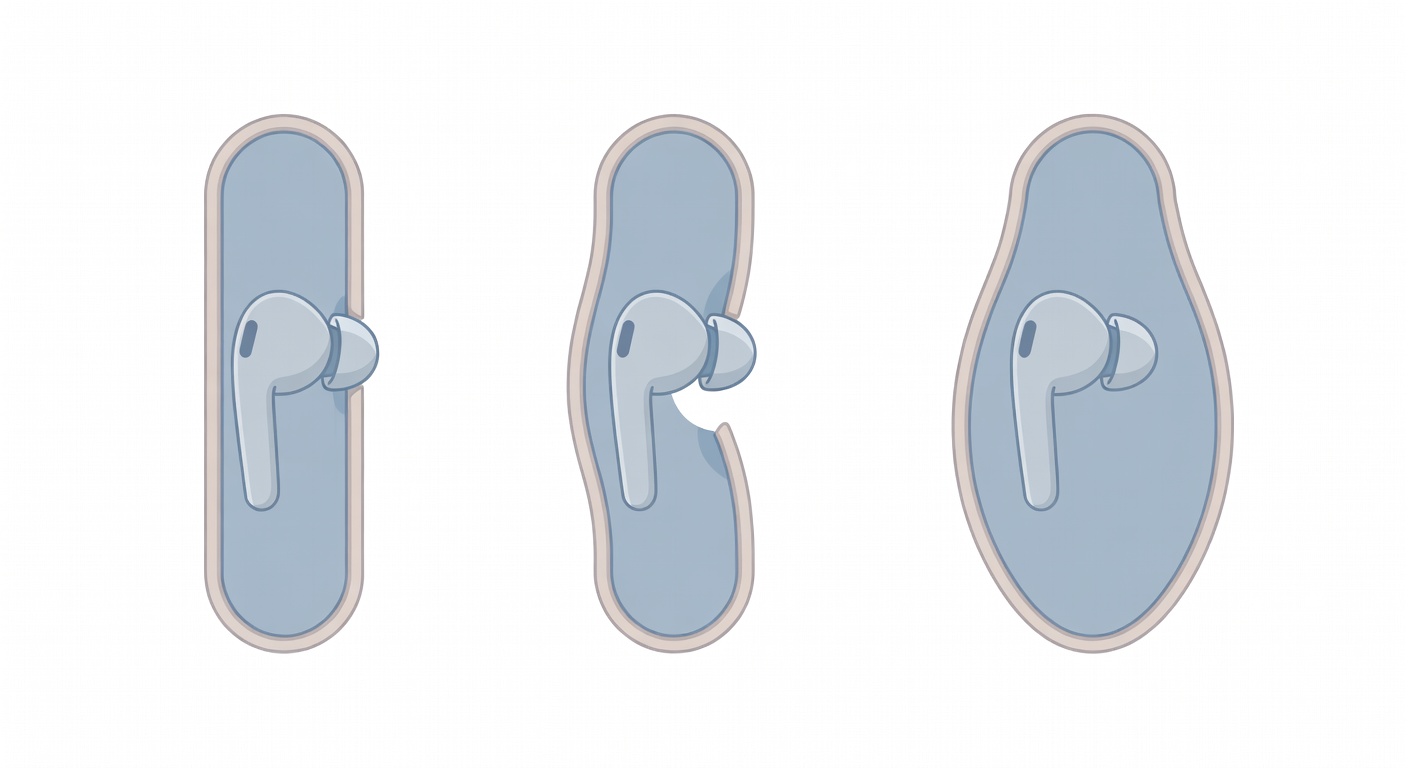
A bad seal can masquerade as “bad ANC,” “thin bass,” and “harsh treble” all at once. The MacRumors flight tester says if you can’t tell the difference, it’s “likely because of a fit issue” (MacRumors).
A tip-size mini-protocol (do this inside the return window)
- Assume your ears don’t match. Start with M on both, then test S and L per ear.
- Insert, then wait 60 seconds. Foam especially needs a moment to expand; silicone needs a moment for you to stop fiddling.
- Do the “jaw test.” Talk, chew, yawn. If the seal breaks, your commute will break it too.
- Do the “hoodie test.” Put on a hat/hood/coat collar. If you trigger controls or loosen the fit, that’s your winter reality.
- Repeat with ANC on and off. If bass and isolation collapse when ANC is off, you’re leaning on processing to cover a weak seal.
One good fit beats one “better” earbud. Every time.
If you feel X, try Y (and what it usually means)
- Pressure / “earplug” feeling: try one size down or switch from foam to silicone. Often it’s an over-tight seal + ANC pressure sensation stacking.
- Bass disappears when you walk: try one size up or a grippier tip. That’s a seal breaking with motion—ANC can’t cancel what’s leaking in.
- Slips when you talk/smile: rotate the bud slightly (different angle), or try a different tip shape/material. Jaw movement is basically a stress test for stability.
- Sharp pain at the tragus/concha after 20–30 minutes: you’re getting pressure on the outer ear, not just the canal. Try a smaller housing (different model) or a shallower insertion tip.
- Occlusion (your footsteps sound like a drum): try a slightly looser seal (smaller tip) or a semi-open design. Strong seals amplify body noise—normal, but not always tolerable.
- Treble feels harsh/sizzly: before you blame tuning, check seal. A leaky fit can shift perceived treble and make you crank volume (which makes it worse).
Do this in the return window:
- Try at least two tip sizes per ear. Left and right may not match.
- Consider foam tips if you struggle with seal (better isolation; can dull treble; they wear out).
- Re-check fit after workouts. Sweat and jaw movement can break a seal that felt perfect on the couch.
Earbuds are shoes. The review can’t change your anatomy.
Sound Quality: Tuning, Adaptive EQ, and the ‘I Have Both and Disagree’ Problem
“Tuning” is just the frequency balance—how much bass, midrange, and treble you get out of the box.
Why sound comparisons go off the rails:
- Adaptive EQ / processing shifts sound based on fit and volume.
- Ear canal resonance means the same earbud can peak differently for different people.
- Tip seal changes bass dramatically.
- Volume matching is rarely done carefully.
The MacRumors thread is basically a live demo: one person says a pair is “No where near” another for sound and ANC, another says “I have both and would say the opposite,” and the in-flight swapper calls their preferred pair “-vastly- superior” (MacRumors).
A buying rule that holds up:
- Podcasts + calls first? Prioritise clarity and stable transparency.
- Gym + hype playlists? Prioritise bass and secure fit over “neutral.”
- Will you use EQ? If you never open the app, stock tuning matters more than “it can be EQ’d.”
Am I paying for performance—or am I paying for vibes?

Everyday Friction: Multipoint, Device Switching, and Ecosystem Traps
This is where marketing copy and real life stop being friends.
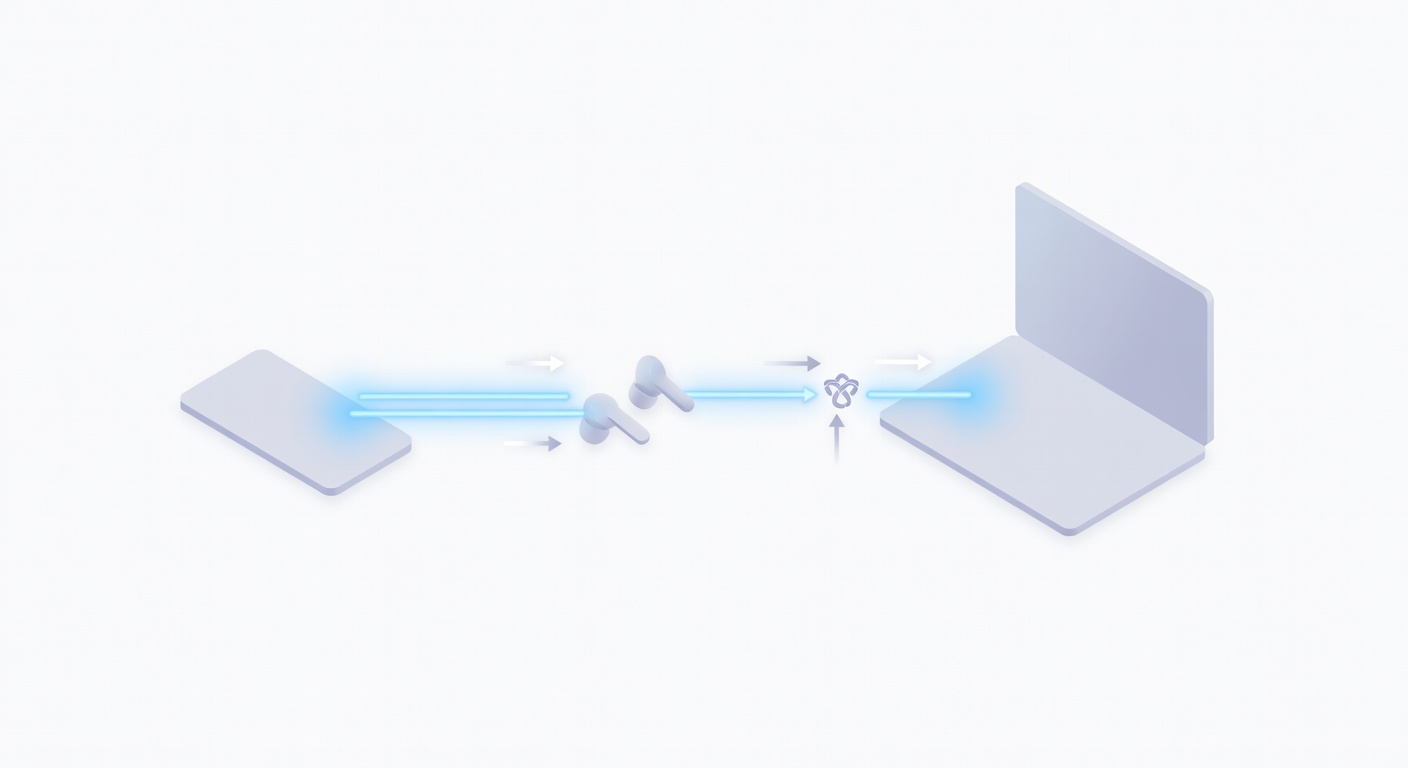
A lot of people buy ANC earbuds for commuting, which means two devices. The AppleVis post lays out that exact use case—books/music on one device, phone calls on another (AppleVis).
Then comes the confusion: one user believes “no wireless earbuds can connect to an apple iPhone and an android device at the same time,” another recommends the Jabra Elite 85t, and the original poster is surprised true wireless can do multipoint at all (AppleVis).
Quick translation:
- Multipoint = connected to two devices at once (with varying behaviour).
- Fast switching = not multipoint; it just reconnects quickly when you manually switch.
Before you buy, check whether multipoint is explicit, whether it’s limited by codec/mode, and whether it requires an app toggle (sometimes it does).
What’s the hidden dependency—an app, an account, a specific cable?
Quick Multipoint Reality Check (What to Test in 10 Minutes)
Do this the day you unbox them:
- Pair to Device A and Device B.
- Start music on A.
- Trigger a call/notification on B. Confirm what happens (auto-switch, pause, or chaos).
- Reverse it.
If multipoint is make-or-break, don’t assume. Verify—then decide if you can live with the behaviour you actually get (AppleVis).
App Friction: What You’ll Actually Have to Tap (Apple vs Sony vs Jabra)
This is the part nobody mentions until you’re staring at a firmware prompt while sprinting for a train.
- Apple (AirPods Pro 2): setup and controls live in iOS Settings (no separate app). Great if you’re all-in on Apple; annoying if you want cross-platform control. SoundGuys also notes you need an Apple device for firmware updates (source).
- Sony (WF-1000XM5): Sony Headphones Connect works on iOS/Android, and you get a real EQ and deeper control. RTINGS calls out that customizability as a key differentiator (source).
- Jabra (Elite 85t): Sound+ is where you’ll tweak controls and sound, and the datasheet is explicit about multi-connect (pair up to 8; connect up to 2) (source).
App/UI friction comparison (no screenshots, just the stuff you’ll feel)
| Friction point | AirPods Pro 2 | Sony WF-1000XM5 | Jabra Elite 85t |
|---|---|---|---|
| Setup time | Fast on iPhone; Apple-first flow | App-guided on iOS/Android | App-guided on iOS/Android |
| Firmware update friction | Requires Apple device access for updates (source) | Updates via Sony app; more knobs, more prompts | Updates via Jabra Sound+ (feature-heavy, can be fussy) |
| Multipoint | No classic multipoint; relies on Apple device switching | Wider support for multi-device pairing per RTINGS (source) | Multi-connect: pair up to 8, connect up to 2 (source) |
| EQ depth | No built-in EQ; third-party if you care (source) | Graphic EQ + presets (RTINGS verdict) (source) | Customizable EQ via Sound+ (datasheet) (source) |
| Gotchas | Best experience is iPhone-only; Android is “basic mode” | Foam tips can be divisive for comfort (source) | Older model; still great on paper for multipoint, but expect more “settings archaeology” |
Comfort, Controls, and ‘Will They Stay In?’ (Workouts Count)
Comfort is the slow-burn dealbreaker. Not sound.
One MacRumors user sums up the common reality: they think the Sony sounds better, but “for my ears though, the Sony do not stay in when I exercise” (MacRumors). That’s not a spec-sheet problem. That’s a Tuesday problem.
My rule: stability matters as much as ANC if you move. If you’re adjusting an earbud every five minutes, you’re not enjoying your music. You’re managing a tiny crisis.
Controls are the other sleeper issue:
- Touch controls can be great—until hats/hoodies/hair enter the chat.
- Stem squeeze / physical buttons reduce accidental taps, but some people hate the feel.
How annoying is it when you’re in a hurry?
Battery Life in Real Life: A 3-Day Usage Test (ANC On vs Off)
I’m not going to pretend everyone uses earbuds the same way. But you can run a simple, repeatable test that catches the stuff spec sheets hide.
3-day battery protocol (repeatable, not “vibes”)
- Same phone all three days. (If you switch phones, you’re also switching Bluetooth behavior.)
- Two volume targets: ~50% (normal) and ~75% (noisy commute).
- Two ANC modes: ANC On for Day 1, ANC Off for Day 2, then your real mixed use on Day 3.
- Mixed content: 60–90 minutes music + 15 minutes calls per day (calls hit battery differently).
- Log the boring stuff: start %, end %, and whether multipoint was active (it can increase radio activity).
Battery comparison table (benchmarks we can actually source)
| Model | Claimed earbuds-only (ANC on) | Measured earbuds-only (ANC on) | Measured earbuds-only (ANC off) | Test volume/conditions | Notes |
|---|---|---|---|---|---|
| Sony WF-1000XM5 | — | 9:32 (SoundGuys, ANC enabled) (source) | — | SoundGuys controlled playback test; ANC on | One of the longer runtimes reported for flagship ANC buds (source) |
| Jabra Elite 85t | Up to 5.5 hours (ANC on) (source) | — | — (claimed up to 7 hours with ANC off & HearThrough off) (source) | Manufacturer datasheet (not a lab measurement) | Multipoint: connect up to 2 devices at a time (source) |
| Apple AirPods Pro 2 | — | — (not available in provided lab sources) | — | — | Battery figures for Pro 2 weren’t included in the provided RTINGS/SoundGuys source set, so I’m not going to invent them. |
Important: “claimed” and “measured” aren’t interchangeable. Use the 3-day protocol above to sanity-check your own real-world runtime (especially at ~75% volume).
So Which Should You Buy? A Simple Decision Tree (AirPods Pro 2 vs Sony WF-1000XM5 vs ‘Other’)
I’m not crowning a universal winner. That’s nonsense—this stuff flips on fit, processing, and what devices you use, as the MacRumors back-and-forth makes painfully clear (MacRumors).
Here’s the decision hinge I’d actually use:
- Buy AirPods Pro 2 if: you’re on iPhone and you value low-friction switching, good transparency, and “it just works” behaviour more than tinkering.
- Buy Sony WF-1000XM5 if: you’ll try tips, tweak settings, and you care a lot about your personal sound/ANC balance—and they stay put in your ears. RTINGS also frames Sony’s advantage as customizability (graphic EQ/presets) and wider multi-device support (source).
- Pick “other” (multipoint-focused) if: two-device life is non-negotiable. The AppleVis thread is a reminder that multipoint is a real buying requirement, and models like Jabra Elite 85t have been recommended specifically for it (AppleVis).
Don’t shop by brand loyalty. Shop by your one intolerance: fit, latency/switching, or app nonsense.
If you buy it for the right reason, you’ll be happy. If you buy it for the marketing reason, you won’t.
CTA: If you tell me your phone(s), your main environments (subway, office, flights), and whether you need multipoint, I can sanity-check which direction makes sense—and what to test before your return window closes.
Prices and Value: ‘Price per Feature’ Without the Spreadsheet Headache
I can’t give you “current street prices” for AirPods Pro 2 / WF-1000XM5 / Elite 85t from the research pack without making things up—the only explicit price points in the provided excerpts are for other models (like AirPods Pro 3) and general deal callouts (source).
So here’s the honest version: value is still measurable without pretending we have perfect price data. Use ANC attenuation (RTINGS) and measured battery (SoundGuys) as your “performance anchors,” then compare against whatever price you see today.
Value table (fill in today’s price; the performance anchors are sourced)
| Model | Typical price (date) | ANC measurement reference | Battery measured (ANC on) | Multipoint | Value call (1 line) |
|---|---|---|---|---|---|
| AirPods Pro 2 | Varies (check today) | RTINGS: airplane -23.46 dB; office -21.69 dB (source) | Not in provided sources | No (Apple switching instead) | Best value when you price in “less faff” on iPhone. |
| Sony WF-1000XM5 | Varies (check today) | RTINGS: airplane -18.81 dB; office -18.64 dB (source) | 9:32 (SoundGuys) (source) | Yes (multi-device pairing called out by RTINGS) (source) | Value spikes if you’ll actually use EQ + multipoint and you want long single-charge runtime. |
| Jabra Elite 85t | Varies (often discounted; check today) | No comparable attenuation values in provided sources | No lab measurement in provided sources (claimed up to 5.5h ANC on) (source) | Yes: connect up to 2 devices (source) | Buy for multipoint-first life, not for “best ANC” bragging rights. |
How to do “ANC per $” and “hours per $”: take the sourced ANC attenuation (e.g., airplane dB) or measured hours, then divide by today’s price you see. It’s crude, but it’s honest—and it keeps you from paying extra for features you’ll never touch.
Sources
- MacRumors forum thread: “I tried Air Pods Pro 3 vs Sony’s WF-1000XM5”
- AppleVis forum thread: “Inexpensive bluetooth active noise cancelling earbud with multipoint”
- RTINGS comparison: AirPods Pro 2 vs Sony WF-1000XM5
- SoundGuys: Sony WF-1000XM5 vs Apple AirPods Pro 2
- Jabra Elite 85t datasheet
- Wirecutter Electronics section
- Engadget
- CNET: Best Wireless Earbuds of 2026


Leave a Reply