Edge Computing in Retail: Real-World Gains for In-Store IoT
Some later links are Amazon Associates. As an Amazon Associate, TelcoBlade earns from qualifying purchases. Live prices are on Amazon.
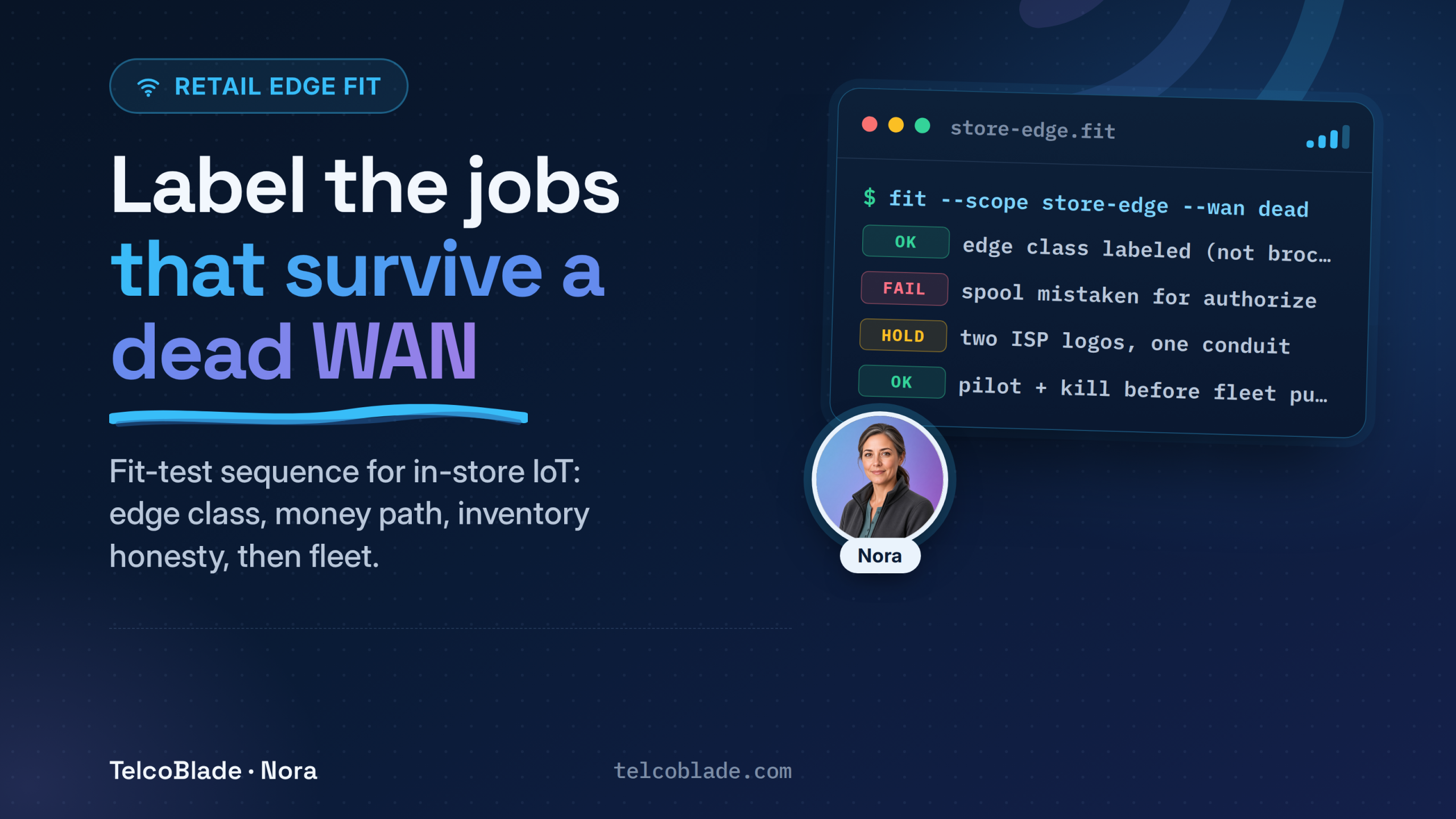
A common failure mode in edge computing in retail is a purchase order for a platform before the must-survive-WAN-loss jobs are named. Operators often cut the PO because the brochure says distributed infrastructure and the demo says smart store. Nobody answers which boxes, owned by whom, and what offline actually means for payments.
This is a one-sitting fit-test sequence. Label the edge. Label the workloads. Prove the money path. Prove inventory and video honesty. Then own the fleet. The gains are not the platform; they are the jobs that keep ringing through a dead WAN because you placed them correctly.
Prerequisites: Leave the Platform Brochure at the Door
The structural failure mode is a purchase order for a retail edge platform that arrives before anyone names the jobs that must survive WAN loss. HCI and use-case catalogs sell a box class, not a placement decision.
Start with a plain list of applications, not a vendor menu. For each app ask: at minute five of a dead WAN, does the store still ring? If yes, that app is a fit-test candidate. If no, cloud-OK. The goal is not to shrink the shopping list. It is to make the vendor shopping list irrelevant until the fit tests pass.
Before I trust a placement claim, I ask who patches the OS, who holds the configs, and who is responsible when the box boot-loops at 7 a.m. Answer those before comparing port counts or claiming edge readiness.
Step 1: Label Which Edge You Mean Before the Purchase Order
Goal: separate four edge concepts before procurement.
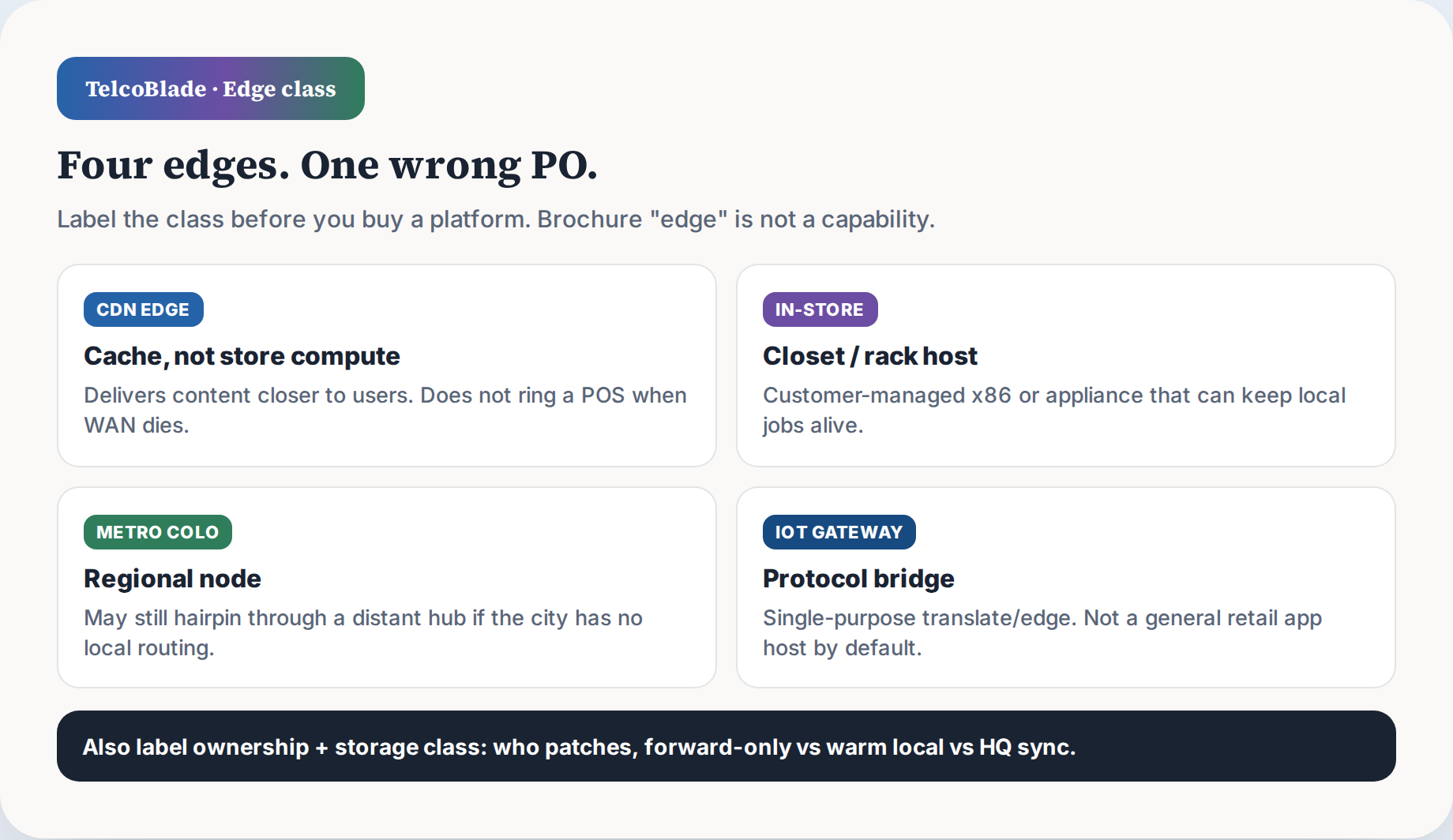
Action: write one of these four labels per site and per appliance.
# Edge class labels
CDN_edge                # Content delivery edge, not an in-store compute host
in_store_server         # Customer-managed x86 host in the store closet
metro_colo              # Regional colocation facility, may hairpin through distant hub
single_purpose_iot_gw   # Protocol bridge, not a general app host
A CDN edge is a cache. An in-store server runs POS cores. A metro colo is not a store. A single-purpose IoT gateway speaks Modbus or OPC. They fail differently, patch differently, and cost differently. Buying one and calling it the edge is how you discover you have a bandwidth bill with a lens, not a compute strategy.
Ownership follows the label. Before I trust a placement claim, I ask who patches the OS, who holds the configs, and who owns the 7 a.m. boot-loop call. Provider-managed appliances hide those answers in an opaque portal. Customer-managed closets hide them in a truck-roll. Neither answer is wrong. Both need to be named.
Storage class goes here too. Forward-only means events leave and nothing warms local. Warm local means the box keeps a working set for offline reads. HQ sync means the store reconciles upward later. This choice changes power, disk, and backup decisions before hardware selection, not after.
Price and TCO often beat latency for placement. Do not start from we need 5G. A metro edge can still hairpin through a distant hub if the city has no local internet routing, so the local label alone is not a latency guarantee.
Checkpoint: every rack item has one edge class, one ownership model, and one storage class before any purchase order.
Step 2: Split Workloads by Must-Survive-WAN-Loss vs Cloud-OK
Goal: sort each in-store app into one of two columns.
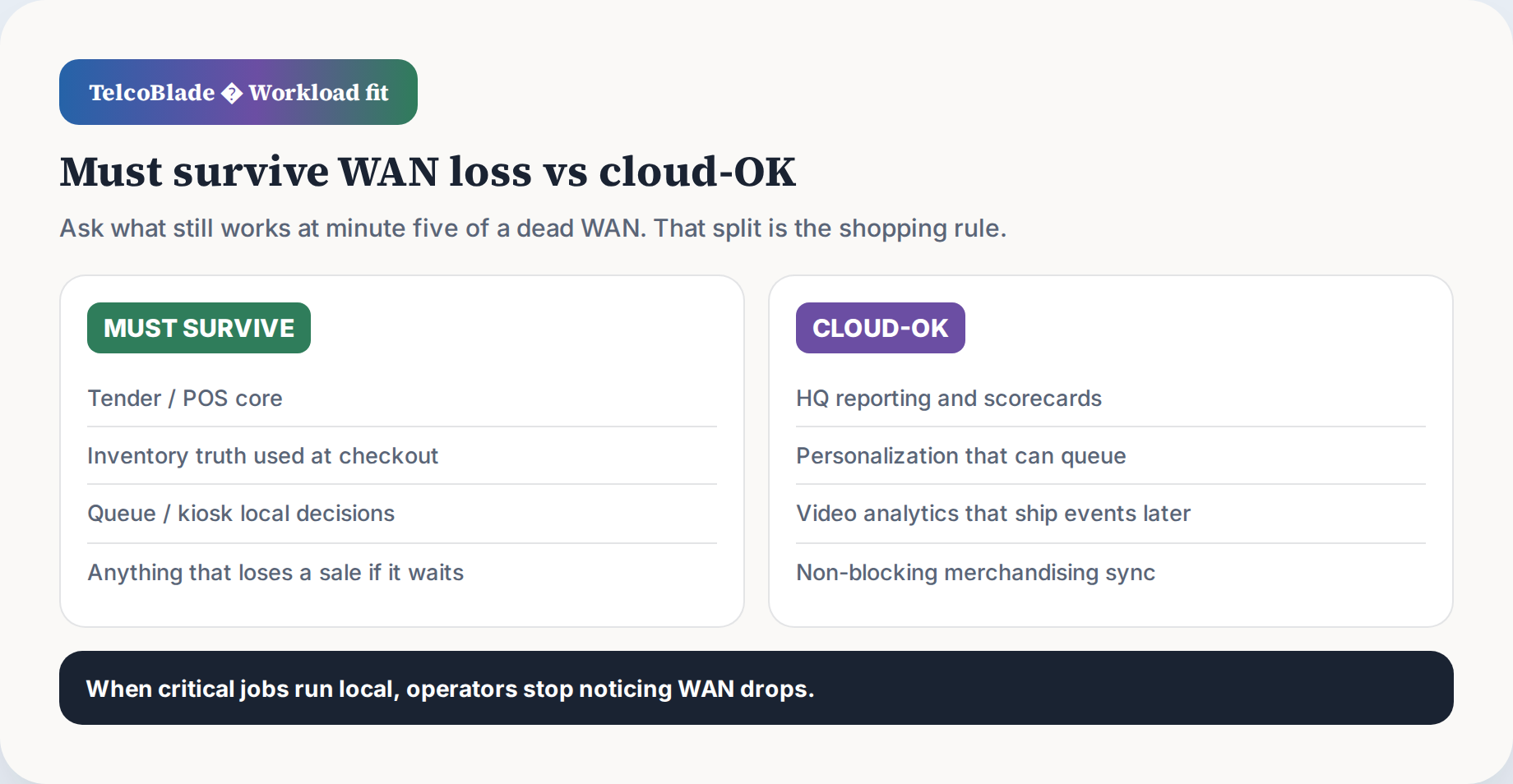
Action: run the fit test against the app list.
# Store workload fit test
must_survive_wan_loss:
  - tender_core          # POS transaction path
  - inventory_truth      # shelf on-hand, last known good
cloud_ok:
  - queue_kiosk_ux       # customer-facing queue display can degrade
  - video_analytics      # event shipping, not raw streams
  - personalization      # loyalty call can queue
  - hq_reporting         # batch sync, not real-time
The split is binary, not vendor selection. Tender core cannot stop when the WAN drops or the store stops ringing. Inventory truth must answer one question locally: what is on-hand at minute five? Personalization can lag. HQ reporting can queue. Video analytics can ship alerts, not raw video.
Industrial transfer lesson: when critical functions run local, operators stop noticing WAN drops. That is a feature. If the store keeps selling through an outage and HQ only notices at month-end reconciliation, the placement was correct.
Hybrid is normal. Not 100 percent on-prem forever. Some apps run cloud-first. The point is that must-survive apps do not become cloud-second by default because a platform catalog says so.
Checkpoint: every app has either must_survive_wan_loss or cloud_ok attached. No app remains edge-ready as a generic label.
Step 3: Prove the Offline POS Money Path Is Not One Feature
Goal: separate store connectivity from bank authorization.
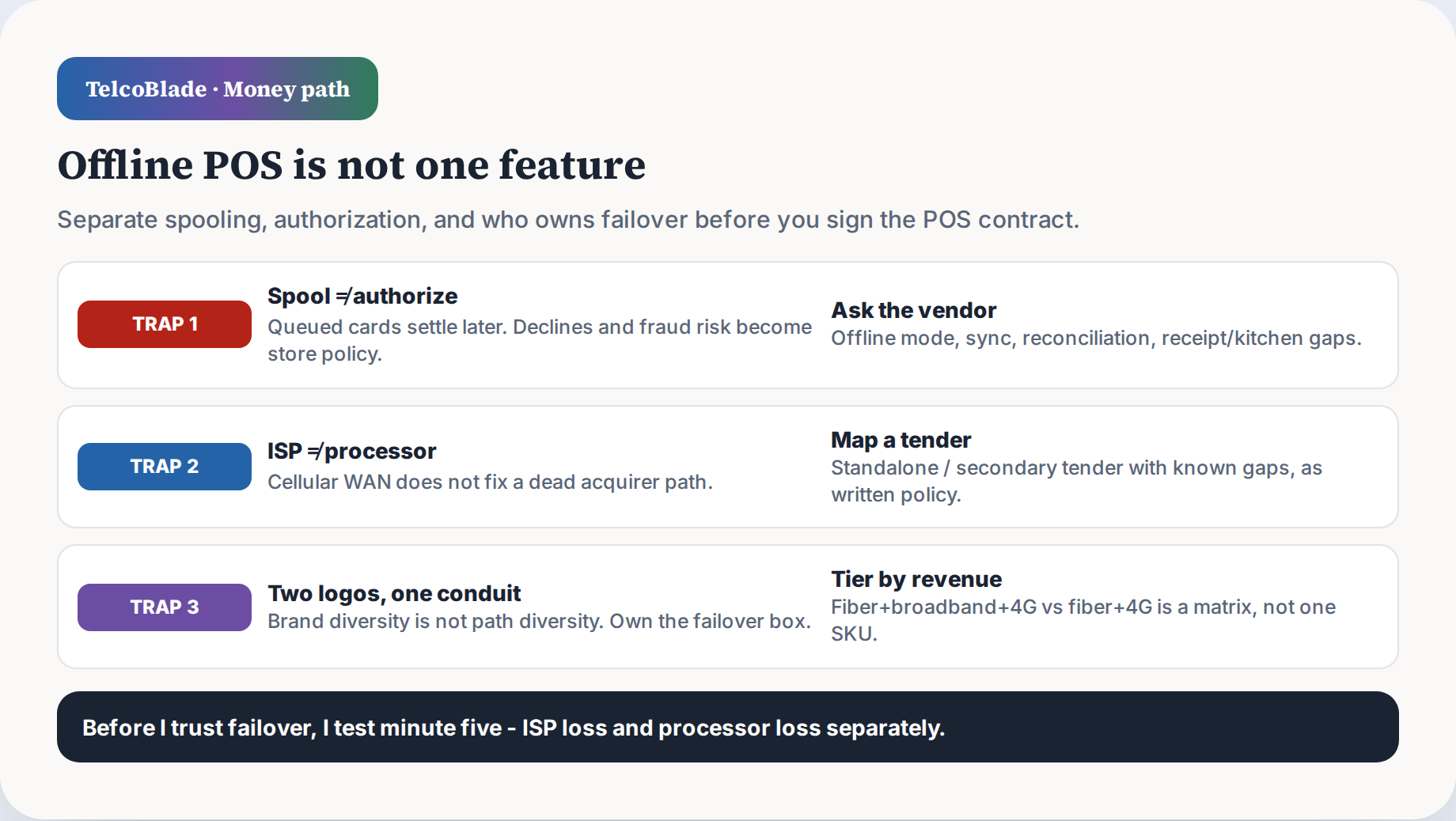
Action: ask the POS vendor these questions before signing.
# POS vendor offline questions
1. Offline mode: can tender core operate without internet?
2. Sync: how does the local spool reconcile with HQ?
3. Reconciliation: what happens when two offline devices sync?
4. Receipt gaps: does temporary tender print correctly?
5. Kitchen gaps: does the order still hit expo?
6. Processor path: what does the terminal do when the acquirer is down but the ISP is up?
Offline spooling is not bank authorization. Queued cards settle later. A decline after settlement is a store policy decision, not a network setting. Transactions that were approved offline can come back declined, charged back, or stuck in purgatory. Decide the policy before the outage, not during it.
ISP outage is not a payment processor or acquirer outage. Cellular WAN does not fix a dead bank path. Map a standalone tender path, even if it is manual card imprint, a secondary mobile tender, or cash. The secondary mobile tender is a temporary path with known gaps, not a silent plan.
For rural and franchise sites, dependable internet is often marketing. Cloud-only POS stops billing when the local ISP hiccups. Hybrid POS continues operating offline and syncs later. That is an operational requirement, not a nice-to-have.
Hotspot or client-mode bridge runbook is written policy for Ethernet-only terminals. Not cowboy. If a terminal has no native Wi-Fi, document exactly who enables the hotspot, on what device, and how the terminal reaches the local spool. If that runbook is not written, the store will improvise.
Checkpoint: money path vendors answered offline, sync, reconciliation, receipt, kitchen, and processor questions. Standalone tender path exists and is written down.
Step 4: Design WAN Resilience for the Store Edge
Goal: build site-specific failover without buying an opaque carrier promise.
Action: audit path diversity and own the failover router.
# WAN resilience audit
primary:        business_fiber_or_broadband
secondary:      automatic_lte_or_broadband
failover_owner: customer_managed_router   # not ISP portal
path_audit:
  - one_building_entrance_shared: check
  - conduit_shared: check
  - carrier_lec_diversity: check
tier_by_revenue:
  high_revenue_store:    fiber+secondary+4g
  mid_revenue_store:     fiber+4g
  low_revenue_remote:    broadband+4g+store_forward
Two ISP logos can share one building entrance or conduit. Auditing logos is not enough. One dig can kill both logos. Carrier and LEC diversity beyond brand names matters. Confirm whether the second circuit shares the same physical plant or a different entrance before you call it redundancy.
Own the failover router. If you cannot see the failover logic, you do not have failover. An ISP-managed opaque cellular backup is false comfort. You need to watch the route fail, test it on a Tuesday afternoon, and confirm the VPN client did not reconnect nine times. When the primary returns, the return path is a failover event too, not a victory lap.
Store-and-forward or sync-when-docked is a design mode for intermittent sites. If the site has no reliable secondary, treat WAN loss as expected and queue locally. When the link returns, sync upward. For deeper cellular WAN and failover hardware, the companion piece, industrial LTE routers for remote deployment, separates antenna and router classes. Optional cellular bench numbers appear in real-world 5G speed test results in 5 major US cities.
If the store runs a guest or ops SSID separate from the POS LAN, test that boundary during failover. The hygiene pattern is the same as in smart home Wi-Fi fixes for connectivity issues.
The table keeps the buying decision visible by tier.
| Store tier | Primary | Secondary | Failover owner | Path diversity audit |
|---|---|---|---|---|
| High revenue store | Business fiber plus secondary broadband | Automatic LTE or 4G failover | Customer-managed router | Separate entrance, separate conduit, carrier and LEC review |
| Mid revenue store | Business fiber | 4G LTE failover | Customer-managed router | Conduit and entrance review plus LEC check |
| Low revenue remote | Broadband plus 4G | Store-and-forward or sync-when-docked | Customer-managed router | Document shared entrance risk and limited carrier choice |
Checkpoint: every store tier has a named primary, a named secondary, an owned failover router, and a documented path diversity audit.
Step 5: Test Inventory and RFID Honesty Before Fleet Rollouts
Goal: avoid buying a shelf-visibility slogan that dies in the last 50 feet.
Action: pilot representative stores with kill criteria.
# Inventory pilot kill criteria
pilot_stores:
  - rural_store_with_spotty_wifi
  - high_volume_store
  - bad_wifi_store
kill_if:
  - empty_shelf_with_on_hand_on_file > 5% after 30 days
  - computer_vision_false_positive > 8% outside training set
  - seasonal_sku_churn_causes_model_drift > 10%
  - opu_labor_interrupts_rfid_audit_beyond_baseline
Empty shelf plus on-hand on file is a last-50-feet location problem, not a platform slogan. RFID tells you the item is in the backroom. The shelf is still empty. If the workflow does not move the item, the edge box did nothing useful.
OPU and ship-from-store labor pulls interrupt idealized RFID audits. Design for broken workflows, not a clean cycle count. Computer-vision inventory fails on reflections, trash cans, spotty Wi-Fi, and seasonal SKU churn. Pilot before fleet. Write kill criteria before the first truck rolls.
Legacy HQ backends can strangle in-store AI even when the edge box is fine. A local inference result that waits eight seconds for an HQ WMS lookup is not local. Map the data dependency path before you claim local decisioning.
The gateway class versus retail app host distinction is deeper in the industrial IoT gateway connectivity and security guide. Here, the honest test is whether a pilot store can prove the last-50-feet result under real labor conditions.
Checkpoint: pilot stores, kill criteria, and data dependency paths are documented. No fleet rollout until the pilot survives minute five of a dead WAN with real inventory tasks.
Step 6: Budget Video, Kiosks, and Bandwidth as Labeled Choices
Goal: treat cameras and kiosks as bandwidth bills, not edge workloads.
Action: label each stream and decision path.
A camera stream is not an edge workload. It is a bandwidth bill with a lens. Ship events and alerts, not raw streams, unless the WAN plan was sized for it and the ISP contract says yes in writing.
Self-checkout and kiosk latency is a labeled choice. Local decision path costs compute but survives the WAN. Round-trip cloud saves compute but stalls at minute five. Label which one the store actually needs before buying a kiosk stack.
Secrets do not live in the browser client. API keys go in a backend proxy or vault. If the proof of concept puts a key in JavaScript, kill it before fleet.
Power and thermal budget for the store closet. A box-fan hack is a smell. If the closet cannot hold temperature, the edge box becomes a seasonal failure. Plan cooling before the first hot Friday.
Checkpoint: every camera stream has an event contract. Every kiosk has a latency label. No API keys leave the backend. Closet power and thermal are budgeted.
Step 7: Own the Fleet and Run the One-Sitting Fit-Test Checklist
Goal: decide whether this is a CI/CD fleet or a truck-roll estate.
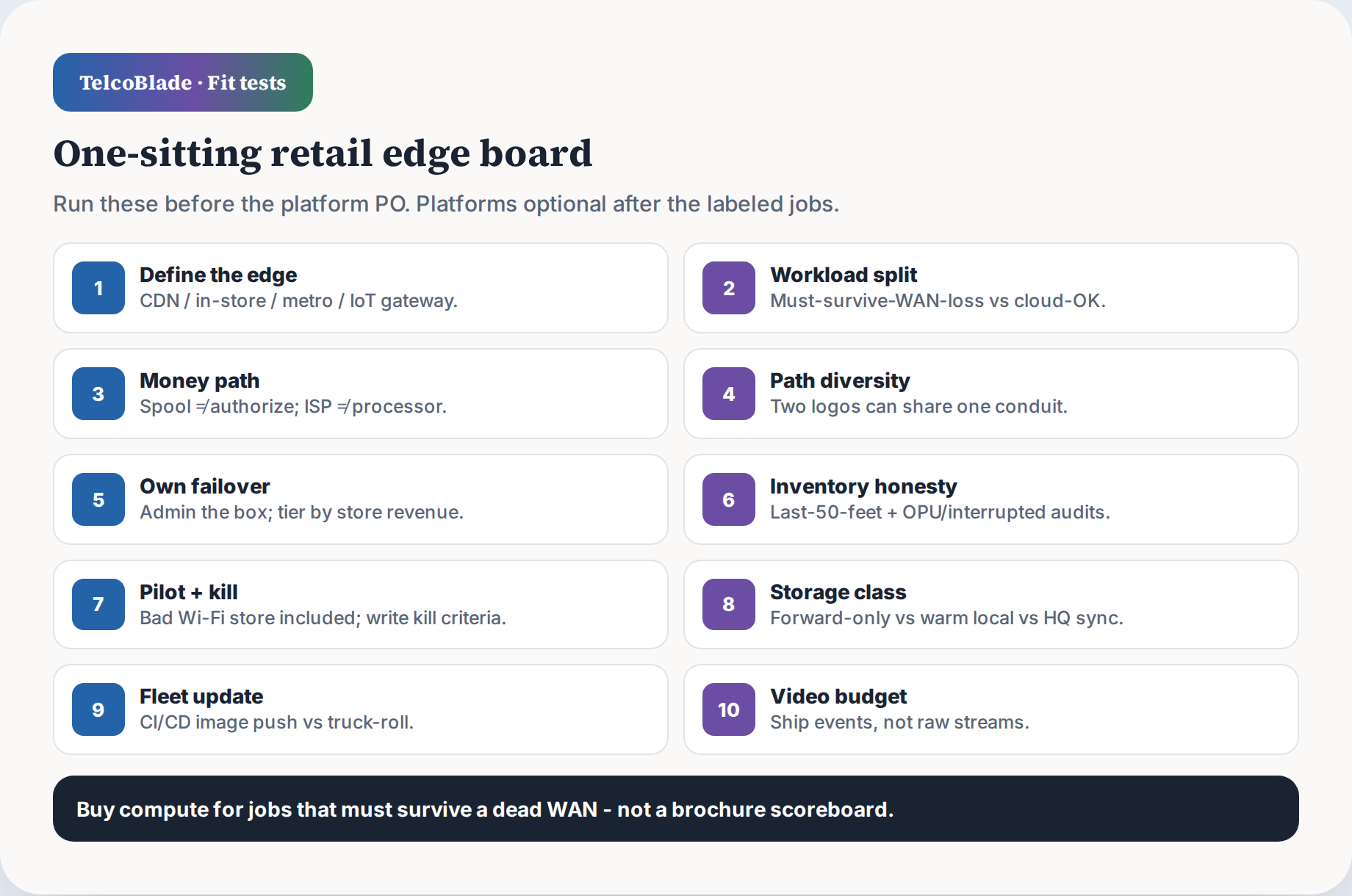
Action: run the one-sitting checklist, then ask how you patch, monitor, and reconcile configurations. If the answer is portal plus keyboard, it is a truck-roll estate in disguise.
CI/CD and container image push is the multi-site ops bar. If you cannot push a container update, you will truck-roll every POS patch. That is not edge computing; that is a field trip.
- ☐ Edge class labeled per site, not assumed from the purchase order.
- ☐ Ownership model named: who patches the OS and who holds configs.
- ☐ Storage class set: forward-only, warm local, or HQ sync.
- ☐ Workload split must_survive vs cloud_ok completed.
- ☐ Offline POS money path verified with processor path pulled.
- ☐ WAN failover named, owned, and tested on a Tuesday afternoon.
- ☐ Inventory pilot kill criteria written before fleet rollout.
- ☐ Video and kiosk latency labels set, no API keys in browser.
Outage triage runbook: one terminal down versus whole store versus whole chain. Name stakeholders and mitigations. A one-terminal failure should not trigger a fleet-wide emergency.
Buy compute for the jobs that must survive a dead WAN. Platforms are optional after the fit tests. That is the real-world gain: ring through the WAN drop, not the vendor slide.
Checkpoint: the checklist is complete and signed by store ops, not just IT. The fleet update path is a container push or a truck-roll, not both by accident.
Outage Triage: Terminal vs Store vs Chain
Outage triage is not one runbook with a larger font. It is three separate decisions that should be written before the first outage.
- Terminal-level. One POS offline mode, receipt gap, kitchen/expo gap, or hotspot runbook. Verify the local spool and tender path before touching network gear.
- Store-level. WAN failover ownership, path diversity, and local spool reconciliation. Test the route fail and confirm the VPN client did not reconnect nine times.
- Chain-level. HQ sync, month-end reconciliation that notices the outage, and fleet-wide configuration drift. A single store outage should not become a chain-wide patch party until the drift pattern is confirmed.
Checkpoint: the triage path is written and names who owns each level before the first outage.
Troubleshooting Common Issues
- Offline POS “worked” in test but died in a real processor outage. Fix: test offline mode with the processor link pulled, not just the WAN unplugged. Reconcile the spool afterward.
- Failover caught ISP loss but not acquirer loss. Fix: map a standalone tender path. Cellular WAN does not fix a dead bank path.
- Two ISPs share one conduit, so both died. Fix: audit physical entrance and conduit path. Diversity is not logo diversity.
- CV model drifted after seasonal SKU churn. Fix: retrain on current seasonal SKUs, include reflections and trash cans in the training set, and set a drift threshold kill criterion.
- Sync conflicts after offline spooling. Fix: ask the vendor what happens when two offline terminals sync. If the answer is vague, use sequential spooling or a conflict resolution policy before signing.
- Secrets exposed in browser client. Fix: move API keys to a backend proxy or vault. Delete the client-side key. Removal is the primary fix, not credential rotation.